
6
A Vision for Improving Teacher Education and the Teaching Profession
As noted throughout this report, numerous commissions, committees, and state and national organizations have recently addressed the need for improving the teaching of science and mathematics in the United States and, hence, the preparation and professional development of teachers in these disciplines. The Committee on Science and Mathematics Teacher Preparation (CSMTP) has reached similar conclusions. Committee members strongly support the idea that leaders in national, state, and local governments, and all education communities must declare that the improvement of teacher education is a top priority. Most critically, our nation’s colleges and universities must embrace this imperative. Committee members concur with the recent statements of the American Council on Education (1999), the Presidents and Chancellors of the Association of American Universities (1999), and U.S. Secretary of Education Richard Riley (1998, 2000) regarding the role of higher education in improving teacher education: teacher education must become a central focus of the entire institution, not just of schools or departments of education. The committee also strongly supports the specific recommendation from the American Council on Education (1999), “Where teacher education programs operate at the periphery of the institution’s strategic interests and directions, they should be moved to the center—or moved out.”
The CSMTP’s examination of research data, recommendations, and current practices also has convinced members that significant improvement in recruiting, preparing, inducting, and retaining teachers for the teaching of science and mathematics in grades K-12 demands fundamental changes in our current systems of teacher education. Small adjustments cannot and will not
|
Improving teacher quality is at the heart of our national effort to achieve excellence in the classroom. This comes at a time when the very structure of education is going through a profound change. With knowledge all around us, available anytime and anywhere, the role of the teacher is going to be fundamentally transformed in the 21st century. In the future, schools will be more fluid, teachers more adaptable and flexible, and students will be more accountable as the task of learning becomes theirs. The challenge of the modern classroom is its increasing diversity and the skills that this diversity requires of teachers. This is why we need to do some new thinking when it comes to the teaching profession. We need a dramatic overhaul of how we recruit, prepare, induct and retain good teachers. The status quo is not good enough. And we must revamp professional development as we know it. New distance learning models can be powerful new tools to give teachers more opportunities to be better teachers. Our efforts to improve education will rise or fall on the quality of our teaching force, and higher education has the defining role in preparing the next generation of teachers. I ask leaders in higher education across the nation to please make this their mission. Richard Riley, U.S. Secretary of Education, 2000 |
|
Not long ago, a college chemistry professor grew angry with the way her daughter’s high school chemistry class was being taught. She made an appointment to meet with the teacher and marched with righteous indignation into the classroom—only to discover that the teacher was one of her own former students. Yates, 1995 |
result in sustainable improvement of science and mathematics. Nor will small changes improve science and mathematics teaching as a profession that attracts and retains the most qualified practitioners.
TEACHER EDUCATION IN THE 21ST CENTURY
Based on its findings and conclusions, CSMTP proposes a new level of partnership between K-12 schools and the higher education community that is designed to ensure high-quality teacher education. This teacher education model would stress and foster greater integration of the initial preparation of teachers and the professional education of teachers throughout their careers. Each college or university with a program designed to prepare college students for teacher certification and the teaching profession would enter into long-term partnerships with one or more school districts. The goal of these partnerships would be sharing the responsibilities of educating future teachers and providing ongoing professional development opportunities for the teachers in the participating K-12 schools.
In these new partnerships, master/ mentor teachers in partner school districts would have adjunct appointments with the schools of education or the departments of science, mathematics, or engineering within the partner colleges or universities. These teachers would take on a significant role in the mentoring of future teachers during their practicum experiences. In turn, colleges and universities would assume a greater responsibility for providing professional development opportunities for teachers who teach in the partner school districts.
This arrangement would be a partnership in the truest sense, as college faculty and K-12 teachers would work together on a continuous basis to improve the teacher education process and to determine the on-going professional development needs of the teacher workforce in the partner school districts. At the collegiate level, the partnership would include active involvement by both education faculty and faculty from departments of science, mathematics, and engineering. Similarly, wherever it is the case that future teachers obtain a significant part of their education at community colleges, the partnership should involve both two-and four-year colleges.
The remainder of this chapter elaborates the committee’s vision for these new partnerships.
ARTICULATION OF THE VISION
As a result of nearly two years of study and deliberation, the CSMTP proposes the following six Guiding Principles, which together constitute a new vision for improving teacher education in science, mathematics, and technology:
-
The improvement of teacher education and teaching in science, mathematics, and technology should be viewed as a top national priority.
-
Teacher education in science, mathematics, and technology must become a career-long process. High-quality professional development programs that include intellectual growth as well as the upgrading of teachers’ knowledge and skills must be expected and essential features in the careers of all teachers.
-
Through changes in the rewards for, incentives for, and expectations of teachers, teaching as a profession must be upgraded in status and stature to the level of other professions.
-
Both individually and collectively, two- and four-year colleges and universities must assume greater responsibility and be held more accountable for improving teacher education.
-
Neither the higher education nor the K-12 communities can successfully improve teacher education as effectively in isolation as they can by working closely together. Collective, fully integrated efforts among school staff and administrators in individual schools and districts, teacher unions, faculty and administrators in institutions of higher education, policymakers from local colleges and universities, and parents are essential for addressing these issues.
-
Many more scientists, mathematicians, and engineers must become well informed enough to be involved with local and national efforts to provide the appropriate content knowledge and pedagogy of their disciplines to current and future teachers.
Adhering to these Guiding Principles will not be straightforward, easily accomplished, or inexpensive. To do so will require fundamental rethinking and restructuring of the relationships between the K-12 and higher education communities in SME&T, including financial relationships. It also will require fundamental revamping of teaching as a profession.
The committee also holds that a critical pathway to achieving these changes will be the establishment of K-16 partnerships whose integrated programs and activities go well beyond those of most partnerships that exist today.
The committee envisions that all of the contributors and stakeholders in these partnerships would be recognized
and utilized for their professional expertise in science, mathematics, and technology education. The partners would work collectively toward improving teaching and ongoing professional development for all teachers in the partnership community, including those in higher education. These partnerships collectively would establish and implement goals for improving the learning and academic achievements in science, mathematics, and technology of students in affiliated institutions, including students in teacher education programs and the children in the schools that are members of the partnerships.
It is particularly critical for institutions that engage in partnerships to reexamine their traditional roles in teacher education and the ways in which what they do are financially supported. For example, colleges and universities traditionally have been involved in oversight of education for prospective teachers. However, these institutions actually may be better suited to overseeing the ongoing professional development of practicing teachers. Similarly, school personnel may be better able to organize, oversee, and mentor the practicum and internship phases of teacher education.
In these examples, funding for the various phases of the continuum of teacher education would need to be restructured. Specifically, the CSMTP envisions partnerships that are funded primarily through multi-year, line-item commitments in the budgets of the participating institutions. While gifts and grants from external funders enhance programs and opportunities for teachers, they should not be the main source of support for collaborative partnerships for teacher education. Even for colleges and universities that rely on tuition as a major source of institutional income, the CSMTP holds that supporting these partnerships will yield both explicit and less tangible benefits. In addition to the improved education that declared teacher candidates would receive from this arrangement, institutional participation in a partnership could open windows of opportunity for many other students who might be considering teaching as a career option; engagement in partnership activities might help them make a favorable decision. In addition, the service to and goodwill from the local community that a private institution could engender through its support of a partnership could be invaluable in promoting community relations.
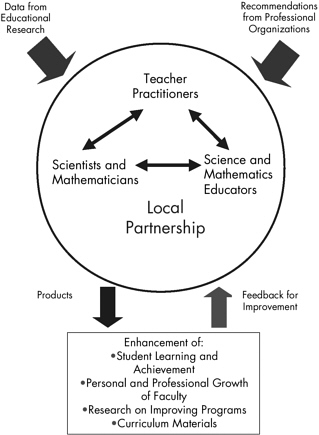
The partnership model that the CSMTP envisions for improving teacher education and the profession of teaching is summarized in Figure 6-1 and described in detail in the next section.
FIGURE 6-1 A model for K-16 partnerships involving the people and resources critical to effective teacher education in science and mathematics. In this partnership model, scientists and mathematicians, teacher educators for science and mathematics, and mentor teachers work as equally essential partners to enhance teacher education and to promote more effective learning and curricular materials for students who attend the schools within the partnership. The members of the partnership also work together to facilitate professional growth and development for each other. The partnership’s programs for teacher education ere informed by (1) educational research, (2) recommendations from national organizations involved with enhancing teaching, and (3) data gathered from the programs sponsored by the partnership itself.
ARTICULATION OF THE COMMITTEE’S VISION FOR TEACHER EDUCATION
The strongest partnerships for teacher education would include, where possible, one or more school districts, two-year colleges, and four-year colleges and universities. Local businesses, industry, research laboratories, local or regional organizations, and individual scientists and mathematicians outside of academe also would be integral contributors to the design, planning, and implementation of these partnerships. Leaders at the highest levels from each of these sectors would need to demonstrate both to their institutions and to the larger community the importance they place on this kind of partnership.
As illustrated in Figure 6-1, teachers of science and mathematics in grades K-12, scientists and mathematicians, and science and mathematics teacher educators would serve as the core participants in this new type of partnership. Representatives from each of these groups who work together in this core would be selected on the basis of their expertise, interest, and commitment to improving teacher education. This core group would commit to developing a culture of recognition, respect, and trust that would give all partners equal voice and responsibility at the table.
Once the partnership was formed, its members would contribute both to the preparation of future educators and the improvement of the knowledge base and skills of all practicing teachers of science, mathematics, and technology in the K-12 and higher education sectors that are involved with the partnership. Implicit in this model is that, through their close professional association and interactions with master teachers from the partnership, scientists, mathematicians, engineers, and teacher educators at colleges and universities will have improved opportunities to enhance their own teaching skills. They also could increase their understanding of how students learn, and reexamine the scope, nature, and relevance of the content that they present in their courses.
New models for broadening the range of student teaching experiences and the planning and supervision of those experiences would be important work for the partnership. Similarly, the partnership would oversee the restructuring of continuing professional development for new and more experienced teachers employed by participating districts.
The policies and activities of the partnership would be informed by (1) educational research (both self-generated and from the scholarly literature—see below) that focuses on
teachers, teaching, and curriculum and (2) recommendations for improving teacher education from national organizations (see Figure 3-1). Activities sponsored by the partnership also might include research involving teacher educators and teachers that explores ways to (1) implement and assess the efficacy of new approaches to teaching, curricula, and learning tools and (2) understand the systemic implications of implementing such changes (e.g., Confrey et al., in press). Partnerships that involve schools or districts and research universities could sponsor studies that focused on ways to improve teaching and learning of science, mathematics, and technology for people of all ages (e.g., AAU, 1999).
Perhaps most importantly, a partnership’s programs for teacher education would be evaluated continually and modified when necessary. Ongoing feedback would come from two primary sources:
-
Evaluation of the science and mathematics activities in local schools and districts that participate in the partnership. Graduate students might undertake these evaluations as theses or district personnel or external evaluators could conduct such evaluations.
-
Collection of data about teachers who complete education and professional development programs sponsored by the partnership, as well as collection of data about the differences in levels of achievement of the students of those teachers.1 Included would be student teachers who had moved to other parts of the state or country after graduation. Collection of such data would be a stimulus to colleges and universities to maintain contact with their graduates and to acknowledge the effectiveness of their teaching programs.
As illustrated in Figure 6-1, partnerships also would engage other resources in the community to contribute to planning and implementation of programs and to provide opportunities for future and practicing teachers to gain hands-on experience with local applications of science, mathematics, and technology. The community re-
sources that could be tapped include businesses, industry, research laboratories, government agencies, and policymaking bodies.
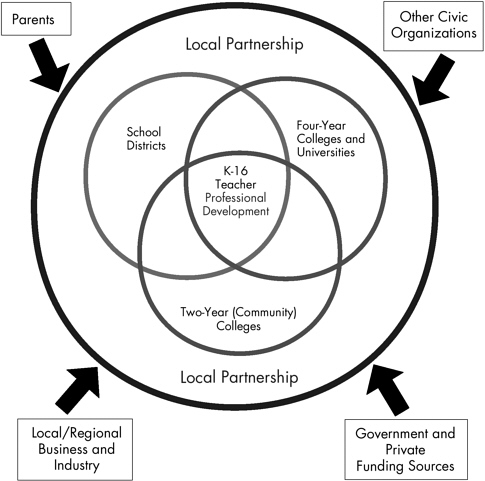
The CSMTP wants to emphasize the critical need for both two- and four-year colleges to be core participants in partnerships and recipients of their value, whenever possible (see Figure 6-2). Recent data suggest that approximately 45 percent of the nation’s undergraduates are enrolled in community colleges (and this percentage is likely to increase during the coming decade: American Association of Community Colleges, 2000). An increasingly high percentage of students may complete their entire undergraduate science and mathematics requirements in community colleges before transferring to four-year institutions to complete their baccalaureate degrees (NSF, 1998). Therefore, faculty in two-year institutions are very much needed to steer students toward additional courses in these subjects and to instill in students who will not go on to additional coursework an appreciation for the life and physical sciences, mathematics, and technology.
Efforts by two-year college faculty to recruit, educate, and support prospective teachers will be undermined, however, if those prospective teachers are not identified as such when they transfer to four-year institutions. Therefore, science and mathematics program planners at four-year colleges and universities need to work with their counterparts at community colleges to ensure appropriate course offerings for these students. Such planning could result in better integration and articulation of course offerings across the institutions, ensuring that prospective teachers receive a similar level of education in science and mathematics regardless of where they enroll in these courses. Community colleges and baccalaureate-granting institutions also should work together to ensure that general requirements for teacher education programs at the four-year institutions can be met by community college courses and that the credits are routinely transferable.
INSTITUTIONAL LEADERSHIP AND COMMITMENT
The presidents and chancellors of both the Association of American Universities (AAU, 1999) and the American Council on Education (ACE, 1999) have made strong statements that leaders of the nation’s colleges and universities, and especially those with schools or colleges of education, need to affirm their institutions’ commitments to teacher education and professional development as central priorities of their institutions. The CSMTP strongly
FIGURE 6-2 Organization of a partnership for teacher education showing the institutions that would contribute. The core of the partnership would be comprised of local school district(s) and two- and four-year colleges where possible. The partnership also would seek additional advice, expertise, and support from local and regional groups including business and industry, governmental and private funding sources, parent organizations, and other community agencies.
supports these declarations. Under the CSMTP’s vision, college and university leaders would recognize the ramifications of real commitment to improving teacher education in science and mathematics. For example, faculty who teach lower division courses might need to restructure both content and pedagogical approaches, especially in courses that will be taken by prospective teachers for grades K-8, where many of these teachers will not become certified or endorsed in these subject areas. Many national organizations have called for all undergraduates to experience science and mathematics through inquiry-based approaches. This could require departments in these subject areas and their institutions to provide the facilities, equipment, and financial resources needed to give all students engaging laboratory and field experiences, including students who traditionally have not chosen such coursework in the past. In addition, postsecondary faculty members who teach such courses need tangible support and recognition for such efforts from their institution’s leadership. These kinds of issues are discussed in greater detail in Chapter 7.
Depending on the structure of the partnership, leaders from the K-12 education community also must express their strong commitment to the success of the partnership. Under the CSMTP’s vision, these leaders would affirm their schools’ and districts’ responsibility to provide funding for ongoing professional development of teachers and for designing a workplace environment that allows teachers to thrive as members of a professional community. In such an environment, time, tangible resources, and support would be provided to teachers for meaningful career enhancement activities. Teachers would have opportunities to work together and with their higher education counterparts to develop and evaluate programs. Both directly and through their participation
|
Once the relationship between the school and the college has been established, the teachers acquire leverage outside their classrooms and schools. The college connection enables teachers to redefine their roles and increase their responsibilities beyond the walls of their classrooms without leaving classroom teaching…. Teachers are provided with visibility and expand their professional influences and self-confidence, enabling them to assume “boundary-spanning” roles that none had experienced previously. Boles and Troen, 1997 |
in the partnership, teachers’ opinions and expertise would be sought for the most important policy decisions in schools and districts. The school workplace would encourage teachers to become leaders and mentors for their colleagues and reward them for doing so.
CHANGING ROLES FOR SCHOOLS, DISTRICTS, AND HIGHER EDUCATION IN TEACHER EDUCATION
The type of close-knit K-16 partnership proposed here offers new opportunities for districts and institutions of higher education to work together in ways that both extend and transcend their traditional roles in the education of science and mathematics teachers. The most common pattern of interaction has been for colleges and universities to take primary responsibility for preservice education and overseeing student teachers. Although classroom teachers may have more direct contact with student teachers or teacher interns, final responsibility for assigning grades and awarding certification usually has rested with institutions of higher education. Once students are graduated and certified, schools and districts then assume responsibility for induction programs and professional development. While colleges and universities may be better equipped to offer practicing teachers better opportunities to learn their subject matter more deeply and to engage in a more intellectual focus on education issues, few have formal agreements with school districts to do so.
Under the proposed partnership, this segregation of responsibilities could disappear, for the most part. Because scientists and mathematicians, teacher educators in these disciplines, and master/mentor teachers would work so closely together, all of them could be much more involved with every phase of teacher education and career development. Master classroom teachers could work together with college faculty in providing high-quality undergraduate courses that integrate content, pedagogy, and educational theory. At the same time, these courses could be more grounded in actual classroom practice and be offered at the sites where preservice students undertake their practicums and other student teaching experiences. Master teachers also could work with scientists and mathematicians who teach primarily content-based courses to help these college-level faculty members focus on appropriate content and better model effective classroom teaching. Improvement of pedagogy in undergraduate courses would benefit all students, majors and non-majors.
Close interaction among institutions also would allow preservice programs to vest greater responsibility for student teaching experiences in partner schools and districts. Contractual agreements would specify the level of service (e.g., direct supervision and mentoring) and interaction to be provided to students and also who would take responsibility for evaluations of student performance. These agreements also would specify the funding that each partner would commit—to support these and other endeavors of the partnership.
The partnerships envisioned here also would provide school districts with opportunities to improve their professional development programs in science, mathematics, and technology. In concert with their employing districts, teachers could earn academic credit and continuing education units at the two- and four-year colleges within their particular partnership or perhaps even within a system of connected partnerships whose teacher education programs are linked through information technology.
In contractual arrangements similar to those between higher education and industry, the institutions of higher education in partnerships could develop and offer ongoing, integrated professional development programs that are geared specifically to the needs of teachers of science, mathematics, and technology. Many college faculty have the expertise, facilities, and equipment necessary to offer to practicing teachers the kinds of higher level courses that they need to gain much deeper knowledge and understanding of the subject matter they teach. Experienced teachers are likely to be ready for such courses; i.e., more motivated and better prepared through their classroom experiences to learn about more abstract issues, such as theories of learning and cognition. Some combination of faculty from the life and physical sciences, schools of education, and master teachers could stimulate levels of professional and intellectual growth that would be nearly impossible for achieve from other, similar programs offered only by districts or institutions of higher education alone.
Partnerships also could work with their state’s department of education to find ways to offer appropriate academic credit to teachers who upgrade their content knowledge and instructional skills in science, mathematics, or technology. The awarding of appropriate academic credit is particularly important for teachers who may not have specific teaching credentials in science, mathematics, and technology but who are expected to teach these subjects anyway (e.g., many teachers of the elementary and middle grades). For these teachers, undergraduate-level courses in science, mathematics, or engineering may be most appropriate.
However, because these teachers already have earned bachelors degrees, some states will not permit them to receive continuing education credits by enrolling in undergraduate courses. Graduate-level courses could be seen as a solution; however, as currently offered, they may not provide teachers with the kind of education and professional development that would best serve their needs. The integrated programs that partnerships could develop and offer to experienced teachers might address the problem not only by offering appropriate courses to teachers but also by assuaging official concerns about whether the credits they would obtain would reflect appropriate academic levels of study.
Teachers in the partnership districts also could engage in research projects in their disciplines by working with college faculty who are involved with the partnership or with undergraduate or graduate students who are engaged in disciplinary or interdisciplinary research. Teachers also could have increased opportunities to undertake research related to the improvement of science, mathematics, or technology education. For example, the partnership could arrange for undergraduate students to work with children in the partnership schools and also establish ways for teachers to share scientific equipment, computing facilities and software, mathematical manipulatives, and other resources owned by the higher education partners. In some cases, college faculty also could benefit by using equipment, such as mathematical manipulatives, that may be more commonly found in the K-12 schools in the partnership. A portion of the funding dedicated to the partnership would need to be set aside to provide teacher participants in this research from both the K-12 and higher education partner institutions with sufficient time to plan, work with undergraduate or graduate students, and evaluate the efficacy of their work.
Clearly, as outlined above, new approaches to and sources of funding would be needed for this model of teacher education. Such funds could be realized from several sources, including those normally set aside by school districts for inservice training of teachers, although, in some school districts, the amount of funds set aside might need to be increased, in recognition of the importance of professional development. Support could be sought from locally based businesses and industries that have publicly acknowledged the importance of science, mathematics, and technology education and possibly even funded such improvements in the past. Support also could be sought from state and federal agencies through existing grant programs (e.g., the
Eisenhower Act for Improving Science and Mathematics Education2 or Teacher Enhancement grants from the National Science Foundation3).
Because the professional development of teachers should parallel the development programs that support people in other professions, the employers of teachers should view ongoing professional development enhancement as a core component of their commitment to their employees. This commitment must include adequate financial support. Financial support from school districts should be an integral component of any budget created for partnerships. The CSMTP emphasizes that, as professionals, teachers should not be expected to pay for programs that are professionally mandated. Rather, given the accumulating body of compelling evidence that student achievement is directly tied to the level of teachers’ knowledge of subject matter and appropriate ways to teach it, districts must view ongoing, high-quality professional development programs for teachers as a critical investment for improving student learning.
OTHER BENEFITS OF PARTNERSHIPS FOR TEACHER EDUCATION IN SCIENCE AND MATHEMATICS
In addition to making more seamless teacher education programs possible, carefully and thoughtfully designed partnerships can provide numerous other benefits to the people and institutions. These include
1. Coordination of efforts to recruit students to science and mathematics teaching. For science and mathematics, teacher shortages appear to be localized, at least at the moment (Darling-Hammond, personal communication with the committee). In addition, Feistritzer et al. (1999b) have presented data suggesting that, unlike many other professionals, new K-12 teachers are likely to find teaching positions close to where they lived before entering college or near the universities where they were educated. This suggests that, through a coordinated effort, partnerships involving local school districts could be especially effective in attracting graduates of local
|
2 |
Additional information about Eisenhower funds is available at <http://www.ed.gov/legislation/ESEA/compliance/eisen.html>. Note that when this report was being prepared for publication, the U.S. Congress had been debating whether to maintain Eisenhower funds for professional development of teachers exclusively in science and mathematics or to make the funds more widely available to professional development in other subject areas. |
|
3 |
Additional information about this program is available at < http://www.ehr.nsf.gov/ehr/esie/TE.htm>. |
high schools to teaching. It is not unreasonable to expect that students of schools participating in partnerships would already have experienced the kinds of teaching that would lay the groundwork for them to go on to become effective teachers themselves. The coordinated teacher education programs provided by the partnerships envisioned here would assist these students in becoming particularly well-qualified teacher candidates.
In addition, through programs and incentives, partnerships could become important catalysts that encouraged high-achieving local students to consider careers teaching science, mathematics, or technology. For example, the partnerships could provide opportunities for local students to interact closely with student and mentor teachers who are involved with the partnership. Partnerships could offer opportunities for prospective teacher candidates to visit and participate in university-sponsored recruiting programs during the school year, on weekends, or during summers. The partnerships also could create a coordinated system of advising that spans the high school and college years to encourage more students to consider teaching as a career.
2. Availability of student teachers and interns. Establishing a formal agreement that makes student teachers and interns available to partner school districts would give these districts ready access to the pool of preservice teachers who are enrolled in the two- and four-year colleges and universities within the partnership. Because all of the parties would have agreed on standards for preservice preparation in science, mathematics, and technology as well as in pedagogy, districts could be assured that these preservice students would be qualified to undertake a practicum, internship, or other teaching experience. In turn, institutions of higher education could be confident that the students they sent out as student teachers would have a teaching experience of high quality, assisted by the district’s own experienced teachers in consultation with the students’ college or university supervisors.
An impediment to this plan is the need for financial support. Many potential teacher candidates, especially those from lower socioeconomic or underrepresented populations, cannot afford to spend extended periods of time in practicums or other kinds of student teaching due to family and other financial obligations. Financial support of potential teachers would enable a more diverse population to consider teaching as a profession.
3. Definition and enforcement of standards of quality for teacher preparation and professional development, including routes for certifi-
cation of science and mathematics teachers. Enforced standards are critical components of effective teacher education. In partnerships, both higher education institution and school partners need to develop mutually acceptable goals and objectives for the programs in which they are engaged and to do what is necessary to ensure that those goals are met. Through contractual agreements and close interaction, the members of the partnership could establish comprehensive expectations and standards both for the providers and the “consumers” of teacher education programs. These expectations could extend well beyond education courses and student teaching experiences. For example, the partnership could work to establish how to make science and mathematics courses for prospective and practicing teachers more relevant and taught more effectively at the partnership’s member colleges and universities.
In addition, by clearly defining what constitutes appropriate credentials for prospective teachers before they begin their student teaching experiences, districts would be assured that these student teachers would be able to handle the challenges that await them in the classroom. Because partnerships as envisioned here also would be able to design and undertake educational research projects that measure and analyze the learning and achievement of the K-12 students being taught, all of the partners would learn how their contributions and efforts for improving practicums and other field experiences for student teachers might be revised or strengthened.
Establishing such credentials for high-quality teaching also might assist those who take non-partnership or nontraditional paths to becoming teachers. For example, students who have graduated from colleges outside the partnership or people who have the requisite knowledge and skills in science and mathematics but who have not taken formal education courses might be able to become teachers in the partnership. At least on a provisional basis, these students could participate in internships and other kinds of professional development on their way to earning full certification. These types of standards and opportunities might have the added benefit of allowing a district to continue to diversify its teaching force.
4. Opportunities for ongoing, informal professional development. One component of the crisis in science and mathematics education is that professionals who work in the cultures of K-12 and higher education rarely know about or understand what takes place in each other’s work environment. Partnerships can provide both formal
and informal opportunities to end this isolation. For example, science and mathematics departments and schools of education typically offer a number of guest lectures, films, debates, and other presentations during the academic year but, typically, teachers do not know about them. The partnership could amend that by making a special effort to inform and invite teachers to such events. The partnership also could arrange participation by teachers in afternoon and weekend field trips and other course-related activities offered by science and mathematics faculty or departments. In turn, schools could target college faculty to participate in various activities and events within their purview. These might include science fairs, where scientists, mathematicians, and engineers are usually needed to serve as judges, the development of nature preserves near partnership schools to allow children to collect and analyze scientific data, or participation in textbook selection or grant-writing teams. Perhaps most importantly, the establishment of partnerships also would make it easier for college faculty, especially those in science, mathematics, and engineering, to visit partnership schools and actually observe what happens in classrooms. These visits could help college-level faculty better understand the kind and level of content being taught in partner schools, allow them to have more informed input to the partnership about that content, and influence their own teaching methods.
5. Enhanced professionalism for teachers. Because teachers are equal partners at the table and critical contributors to the success of the partnership endeavor, teaching as a profession would take on more of the characteristics of other professions. When teachers are required to articulate their ideas, to express clearly what they do in their classrooms and why they do it, and to share their ideas openly with peers and other professional colleagues, their teaching is likely to be enhanced. As teachers become more involved with various kinds of scientific or educational research, they go beyond their traditional roles by helping to discover new knowledge that can then be applied directly to their own classrooms and to the classrooms of colleagues associated with and beyond the partnership. Vesting such responsibilities and authority in teachers results in greater ownership and understanding of teaching as a profession.
Teachers will need time and financial as well as other resources (e.g., availability of qualified substitute teachers, aides) to be full contributors in any partnership. For the partnership to have such a level of contribution from teachers—and to enable teachers to grow as professionals in the process—
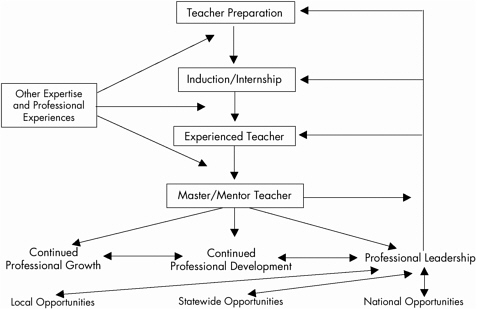
school districts will need to work with their partners to find ways to provide the time and resources required. Providing this time implies that (1) teachers will have fewer contact hours with students each day or week, (2) they will be engaged in (and fully compensated for) their work for a longer period of time each academic year (e.g., by working an extra month during the summers on professional and curriculum development), or (3) some combination of these options. The critical components of a teaching position that could be supported in these ways include professional reflection, continual intellectual engagement, and advancement in the profession (e.g., Figure 6-4), working with colleagues to improve specific curricula, and working with each other and with less senior teachers to improve teaching and learning for all of the schools involved with the partnership (e.g., Ma, 1999). Providing opportunities and the financial support that is required for teachers to become more fully engaged in their profession throughout the academic year is common practice in other nations such as Japan (Stigler and Hiebert, 1997; NRC, 1999c).
6. Sharing of resources and expertise. With few exceptions, colleges and universities in a given geographical area are far more likely than local school districts to have sophisticated laboratory space and equipment, computing facilities, and access to other resources such as library holdings. As partnerships for teacher education in science and mathematics develop and prioritize their issues, sharing of knowledge and resources could become a primary focus. In terms of technology and technology applications knowledge, for example, recent reports (Becker and Anderson, 1998; Milken Family Foundation, 1999; CEO Forum, 1999, 2000; Brandt, 2000) have decried the lack of preparation of future teachers in the appropriate use of information technology, as well as the continued need for practicing teachers to work to incorporate general purpose technology tools into core instructional activities. Because of their familiarity and comfort with using sophisticated information technology tools and software, scientists and mathematicians from the partnership and their expertise could be engaged to address these issues more fully. In turn, these scientists and mathematicians also could apply their experiences from such efforts to address appropriate applications of information technology in undergraduate classrooms and laboratories for a wider spectrum of students.
In terms of equipment resources, members in a partnership might decide that certain kinds of expensive instru-
mentation and equipment would be useful both in high school and introductory college laboratories. The existence of the partnership could then open the door to the sharing of current equipment or the pooling of funds to jointly purchase new equipment, with obvious cost savings benefits. More efficient use of the equipment over the academic year and during the summers might also be arranged.
FINANCIAL SUPPORT FOR PARTNERSHIPS FOR TEACHER EDUCATION
The kind of partnership program described here should be viewed as a model that can be adapted to local or regional situations: therefore, estimating precise costs of establishing, operating, and sustaining such an effort is not possible. However, the committee’s vision—that institutions of higher education and school districts share responsibility for all phases of teacher education and professional development—also must extend to the ways in which partnerships are supported financially. Accordingly, the CSMTP suggests that funds previously devoted by individual organizations to their current programs in teacher education be pooled within the partnership. Through contractual agreements, the respective partner organizations would authorize the partnership to spend these funds as needed to provide a continuum of support of teacher education.
Under this plan, it is entirely possible that funds which colleges and universities would otherwise expend to support their own student teacher programs might be used instead by school districts, if the partnership determined that districts should assume primary responsibility for this phase of teacher education. Some of these funds might be used by the partnership to support mentor teachers who would work with university faculty members to teach preservice courses. Likewise, school district funds previously used to support district professional development programs might instead be transferred to institutions of higher education within the partnership to support continuing professional development programs.
By combining these separate line items from the various partners, the partnership could enjoy flexibility in deciding how to develop its programs. By pooling such funds, the partnership also could then determine whether additional funds are required. Those funds could then be sought from a variety of sources, including school boards, deans or provosts, local, state, and federal government agencies, or private sources. Once a partnership had a coordinated policy for teacher educa-
tion and a pool of funds to support it, the partnership could more easily justify the need for additional funds. As always, the argument for expending any funds for the partnership’s efforts at any time would be to support more effective teacher education programs.
An important consideration in this approach to teacher education in science and mathematics would be the reduction or possibly even the elimination of redundancy of effort, programs, and equipment. Although formal financial analyses would be required for each partnership, CSMTP members predict that the sponsoring organizations either would actually save money or obtain more services than would be possible if each organization continued to operate its own programs divorced from the activities and priorities of others.
POTENTIAL OBSTACLES TO SUSTAINING AN EFFECTIVE PARTNERSHIP FOR TEACHER EDUCATION
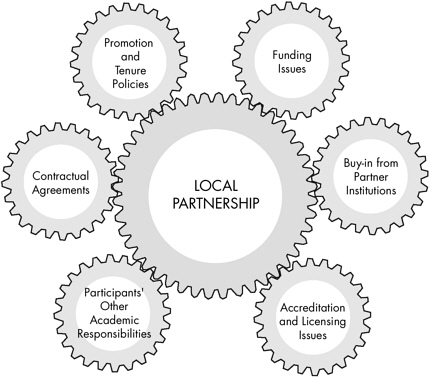
Leaders both within the core of a partnership and in the institutions that support it must recognize and attempt to mitigate the many external variables that could compromise the success and vitality of the partnership (see Figure 6-3). For example,
-
Current tenure and promotion policies at many colleges and universities may not sufficiently recognize the contributions of faculty in science, mathematics, engineering, and in education departments to the improvement of teacher education through such partnerships (e.g., NRC, 1999h). In many cases, these kinds of partnership activities require more commitment of time, effort, and intellectual engagement than other, more traditional faculty responsibilities. If institutions and faculty colleagues who are not engaged in such activities do not recognize and reward such efforts, partnerships are not likely to be sustained over time.
-
Sufficient funding for successful partnerships must be both predictable and available long-term. Budgets that are subject to annual negotiation can have a negative impact on this kind of compact. Partnerships that depend too heavily on grants rather than on line items in the budgets of school districts and postsecondary institutions can be compromised if the priorities of funding agencies shift over time.
-
Real buy-in by a partner institution has ramifications for the entire institution. Partnerships cannot be optimally effective if one or more partners are unwilling or unable to meet their commitments. Contractual agreements must be equitable and supported financially through line items in the budgets
FIGURE 6-3 In the system of gears illustrated above, the large main gear and all of the components with which it meshes must be working synchronously for the system to operate. A malfunction in any one of the smaller gears can cause the entire system to malfunction. Like a system of gears, local partnerships are subject to a variety of external influences. Individually or in combination, these external influences can provide opportunities to move the partnership forward or they can bring the system to a halt, even when other components of the system are functioning properly. Several kinds of external influences on K-16 partnerships are illustrated. Those responsible for such partnerships must understand how external factors can influence their operation.
-
of all parties that are involved with the partnership.
-
As noted before (and in Figure 6-4), the kind of partnership the committee envisions would allow people with appropriate experience and expertise to pursue teaching careers through nontraditional routes to the profession. However, state departments of education or accreditation bodies would need to be involved with this type of opportunity through the creation of policies that enable prospective teachers (both traditional undergraduate candidates and those who pursue teaching later in their careers through alternative pathways) to earn certification through the partnership.
FIGURE 6-4 The continuum of teacher professional development. In this model, teachers have the opportunities for continued professional growth throughout their careers. They also have the opportunity to assume leadership roles in their schools, in partnerships with local colleges and universities, and through leadership in their district, state, and nationally. These experiences, in turn, contribute to further opportunities for individual professional growth and development.
-
Most of the people connected with the kind of partnership envisioned here also would likely have academic and other responsibilities to their home institutions, which, like most jobs in education, might also be more than full time. Unless these contributors are provided with sufficient time and support to engage in the partnership, responsibility for it will probably fall on the shoulders of only a few. To prevent the destructive tensions such a situation can easily generate, all institutions that contribute to a partnership should consider some redefinition of contributors’ jobs to give them the time needed to be true collaborators.
-
The partnerships envisioned here call for new approaches to teaching and assessment of teaching and student learning. Many of the ideas espoused in the committee’s vision for improving teaching and learning may be at odds with current efforts in some districts and states to institute “high-stakes” standardized assessments for both students and teachers. The time required for teachers to prepare themselves and their students for increasing numbers of these examinations could compromise their ability to contribute to the partnership. In addition, the kinds and levels of questions that are being used in some of these tests (e.g., emphasis on facts and information vs. conceptual understanding) could undermine the kinds of teaching that the committee envisions would result as a result of the teacher education within these partnerships.
Finally, and perhaps most importantly, the committee acknowledges that achieving this vision will not be straightforward or easily accomplished. It will require fundamental rethinking and restructuring of the relationships between the K-12 and higher education communities in science, mathematics, engineering, and technology, including financial relationships. Building the kind of capacity that is needed to begin or to grow a partnership for teacher education as envisioned in this report will require a great deal of time and commitment from all parties. It also will require fundamental revamping of teaching as a profession.
Examples of efforts to work toward partnerships for teacher education are included throughout this report (see especially Appendixes D and E). These examples can serve as models for those who wish to begin or expand partnerships to improve teacher education at all phases of teachers’ careers.


