
INTRODUCTION
Astronomers seek to understand phenomena as diverse as the formation of planets, the origin of solar activity, the evolution of black holes, and the large-scale structure of the universe. Electromagnetic radiation—radio, infrared, optical, ultraviolet, x-ray, and gamma-ray—provides most of the information we have on these distant phenomena, but other messengers can contribute as well: Energetic charged particles (the cosmic rays) carry information about where they were accelerated, neutrinos tell us about the deep interior of stars, and gravitational waves may reveal how some black holes form. This chapter describes how the recommended new initiatives grew out of the existing program, how they complement each other, and how they will address the major scientific questions in astronomy. The characteristics of the major and moderate new initiatives are listed in Tables 3.1 and 3.2. More detailed descriptions of the facilities and the science they will accomplish can be found in Astronomy and Astrophysics in the New Millennium: Panel Reports (NRC, 2001).
The committee emphasizes that telescopes alone do not lead to a greater understanding of the universe. So that maximum benefit can be obtained from the current and proposed new facilities, the committee recommends a vigorous and balanced program of astrophysical theory, data archiving and mining, and laboratory astrophysics. One of the key recommendations is the establishment of theory challenges to be associated with most new major and moderate programs. These challenges should describe theoretical problems that are ripe for progress, relevant to the planning and design of the program, and essential to the interpretation and understanding of its results in the broadest context. The specific theory challenges tied to each mission and project should be determined by the informed astronomical community—probably through ad hoc panels, drawn from the theory community and convened for this purpose. However, to illustrate the concept the committee gives examples of possible theory challenges below in the discussion of the new initiatives.
THE ULTRAVIOLET, OPTICAL, AND INFRARED WINDOWS ONTO THE UNIVERSE
Ultraviolet, optical, and infrared (UVOIR) observations provide extremely important sources of information about the universe. Stars,
TABLE 3.1 Characteristics of Prioritized Major Initiatives
|
Project |
Wavelength or Energy Coverage |
Increase in Sensitivitya |
Spatial Resolution (arcsec)b |
Spectral Resolving Powerc |
|
NGST |
0.6 to 27 µm (goal) |
100 to 600 |
|
5 to 5,000 |
|
GSMT |
0.3 to 25 µm |
10 |
|
3 to 105 |
|
Con-X |
0.25 to 40 keV |
100 |
15 |
300 to 5,000 |
|
EVLA |
3 mm to 100 cm |
10 |
|
10 to 107 |
|
LSST |
0.3 to 1 µm 0.3 to 2.4 µm (goal) |
20 to 60 |
0.6 |
3 to 100 |
|
TPF |
3 to 30 µm |
n.a.d |
|
3 to 300 |
|
SAFIR |
30 to 300 µm |
100 to 300 |
|
5 to 103 |
|
aIncrease in sensitivity compared with existing or other planned facilities. bFor entries with a (λ/a) term included, the spatial resolution is for wavelength λ > a. The number in front of the parenthesis therefore corresponds to the best spatial resolution. cSpectral resolving power is defined as λ/Δλ. dn.a., not applicable, is assigned to TPF because there is no existing facility with which to compare the sensitivity. This unique facility will work at spatial resolutions not currently accessible in this wavelength range. |
||||


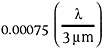

and the interstellar gas and dust that make stars, emit most of their radiation at these wavelengths. The atoms and ions in the interstellar medium and in stellar atmospheres have rich UVOIR spectra that can be used to probe the density, dynamics, magnetic field structure, temperature, and elemental abundances of astronomical objects. Infrared radiation penetrates the obscuring dust that surrounds regions of star and
TABLE 3.2 Characteristics of Prioritized Moderate Initiatives
|
Project |
Wavelength or Energy Coverage |
Increase in Sensitivitya |
Spatial Resolution (arcsec)b |
Spectral Resolving Powerc |
|
GLAST |
10 MeV to 300 GeV |
>40 |
600 |
50 |
|
LISA |
10−4 to 10−1 Hzd |
n.a.e |
1,800 |
3 × 10⁴ |
|
AST |
0.3 to 35 µm |
300 |
|
103 to 106 |
|
SDO |
0.02 to 1 µm |
25 |
1 |
100 to 6 × 10⁴ |
|
CARMA |
860 µm to 1 cm |
4 to 12 |
|
3 to 107 |
|
EXIST |
5 to 600 keV |
1,000 |
300 |
100 |
|
VERITAS |
100 to 104 GeV |
10 |
180 |
10 |
|
ARISE |
3 mm to 4 cm |
n.a.e |
|
20 to 107 |
|
FASR |
1 to 100 cm |
n.a.e |
|
30 to 100 |
|
SPST |
200 µm to 1 mm |
10 |
|
10 to 107 |
|
aIncrease in sensitivity compared with existing or other planned facilities. For EXIST the comparison is with a previous survey by HEAO-1. bFor entries with a (λ/a) term included, the spatial resolution is for wavelength λ > a. The number in front of the parenthesis therefore corresponds to the best spatial resolution. cSpectral resolving power is defined as λ/Δλ. dFrequency of gravitational waves. All other recommended projects detect electromagnetic waves. en.a., not applicable, is assigned to LISA, ARISE, and FASR because there are no existing facilities with which to compare the sensitivity. LISA will be a unique facility operating at frequencies (see footnote above) not accessible to the LIGO experiment. ARISE will operate at unprecedented spatial resolutions. FASR will observe the Sun over an unprecedented frequency range and at spatial and temporal resolutions beyond current capabilities. |
||||


planet formation and many galactic nuclei. Although stars generally radiate mostly at optical and ultraviolet wavelengths, the expansion of the universe transforms such radiation from very distant galaxies to infrared wavelengths. Consequently, a number of the new initiatives cover the infrared portion of the spectrum.
Advances in UVOIR technology offer the promise of enabling great leaps in our understanding of the universe. Typically, these advances bring greater sensitivity—the ability to detect faint signals—and greater angular resolution, the ability to see fine detail in distant objects. Increased sensitivity requires more collecting area, which is most easily achieved with large filled-aperture telescopes. The angular resolution also improves with the diameter of the telescope mirror. However, to achieve the extremely high angular resolution needed for some of the long-range scientific goals described in Chapter 2 would require excessively large mirrors, up to thousands of kilometers in size. For these angular resolutions filled-aperture telescopes are not practical, and interferometers are used instead. Interferometers combine the photons from two or more telescopes to produce the equivalent angular resolution of a single telescope whose diameter equals the maximum separation of the interferometer telescopes. The cost of using interferometers is reduced sensitivity and ambiguities in image reconstruction. The latter can be corrected by reobserving with many different baseline separations and orientations. Interferometers also can cancel the light from the central star in a planetary system so that astronomers can see the relatively dim planets nearby.
Both space- and ground-based telescopes are needed to open the UVOIR window onto the universe. Ground-based telescopes have the advantage that they are generally less expensive and much easier to maintain and upgrade. Space-based telescopes have the advantage that they are free from the distortion, absorption, and background emission of the atmosphere and allow observations in many UVOIR wavelength bands not accessible from the ground: for example, the far ultraviolet (0.1 to 0.3 µm), many regions in the infrared (1 to 30 µm), and the entire far infrared (30 to 300 µm). Even at wavelengths that do reach the ground, the turbulence in the atmosphere blurs the angular resolution of ground-based telescopes. Recent advances in adaptive optics have substantially reduced this problem in the infrared, but it persists in the optical band, particularly for wide-field imaging. Together, ground- and space-based telescopes enable a comprehensive attack on many of the fundamental questions in astronomy.
LARGE FILLED-APERTURE OPTICAL AND INFRARED TELESCOPES: NGST AND GSMT
At the present time, the premier UVOIR telescopes are the Hubble Space Telescope (HST) in space and the Keck 10-m telescopes on the ground. When they are completed, the 8-m Gemini telescopes and the European Very Large Telescope (VLT) will provide powerful additions to the available ground-based telescopes (see Table 3.3). The committee’s top recommendations for this decade are to dramatically increase the capability of UVOIR observations with the Next Generation Space Telescope (NGST) in space and the Giant Segmented Mirror Telescope (GSMT) on the ground. Both of these telescopes have filled apertures and are very substantial improvements on HST and Keck, respectively. Their large mirrors must be segmented, and fast-responding actuators must bring the segments into nearly perfect alignment. The 1990s saw revolutionary advances in the development of lightweight mirrors and segmented structures that will be put to use in constructing these new telescopes.
NGST (Figure 3.1) consists of a passively cooled, segmented telescope that will deploy to its full diameter of about 8 m once it is in space. It will orbit the Sun roughly a million miles from Earth. At present, its planned wavelength range is 0.6 to 27 µm. NGST will be far more capable than its space predecessors HST and SIRTF and its airborne predecessor SOFIA. Figure 3.2 compares the sensitivity of NGST with that of other space facilities at low spectral resolving power, which is appropriate in searches for distant galaxies and faint stellar objects. Much of its increase in sensitivity compared with previous space telescopes comes from its large aperture, which not only gathers more photons from each source but also reduces the number of photons from the background by virtue of its greater angular resolution. Astronomical capability is defined in the 1991 survey, The Decade of Discovery in Astronomy and Astrophysics (NRC, 1991), in terms of the speed of an observation. Improvements in sensitivity and angular resolution make NGST roughly 1,000 times more capable than HST and SIRTF; its low temperature makes it up to a million times more capable than similar-size ground-based telescopes. The discovery potential of NGST is enormous. Having NGST’s sensitivity extend to 27 µm would substantially improve its ability to study Kuiper Belt objects (KBOs) in the solar system, star formation and planet formation in our galaxy, and dust emission in galaxies out to a redshift of 3. Not only would this extension take full
TABLE 3.3 Existing and Approved Large Ground-Based Optical and Infrared Telescopes
|
Project |
Commencement of Operations |
Partners Involved |
Percent U.S. |
Aperturesa |
|
Gemini |
|
United States, United Kingdom, |
|
|
|
Northern |
1999 |
Canada, Chile, Australia, |
52 |
2 × 8 m |
|
Southern |
2001 |
Argentina, Brazil |
42 |
|
|
Gran Telescopio Canarias |
2003 |
Spain |
0 |
1 × 10.4 m |
|
HET |
1998 |
United States,b Germany |
90 |
1 × 9.2 m |
|
Keck |
1993, 1996 |
United Statesb |
100 |
2 × 10 m |
|
LBT |
2002 |
United States,b Italy, Germany |
50 |
2 × 8.4 m |
|
Magellan |
2000, 2002 |
United States,b Chile |
90 |
2 × 6.5 m |
|
MMT |
1999 |
United Statesb |
100 |
1 × 6.5 m |
|
SALT |
2002 |
South Africa, United States,b Poland, New Zealand, Germany, United Kingdom |
20+ |
1 × 10 m |
|
Subaru |
1999 |
Japan |
0 |
1 × 8 m |
|
VLT |
1999+ |
Europe |
0 |
4 × 8 m |
|
aNotation: 2 × 8 m denotes two telescopes with 8-m-diameter apertures. bU.S. private or university telescopes. SOURCE: Includes data from NRC (2000), Table 5.13. |
||||
advantage of the effort to cool the instrument, but NGST would also gain its greatest advantage over any ground-based telescope at the longer infrared wavelengths (see Figure 3.3).
Considerable progress has been made in developing the challenging technology required by NGST, including sensitive detectors, lightweight deployable primary mirrors, and control and image analysis systems. To enable NGST to reach its full potential, the committee recommends technology development to increase telemetry rates in spacecraft communication and for cryocoolers that enable detectors to operate at wavelengths longer than 5 µm.
GSMT complements NGST, both in technical capabilities and in its ability to probe distant galaxies and nearby star-forming regions. GSMT is a 30-m-class, ground-based, filled-aperture, segmented-mirror, optical and infrared telescope that will operate in the atmospheric windows over the wavelength range from 0.3 to 25 µm. Adaptive optics will give it diffraction-limited performance down to wavelengths as short as 1 µm. GSMT will complement NGST much as the Keck telescope has comple-
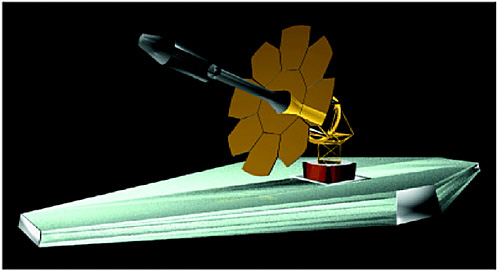
FIGURE 3.1 An artist’s conception of the NGST mission. NGST, the highest priority for the new decade, will be a segmented, filled-aperture, 8-m-class telescope that will utilize a large sunshield and an orbit at least 1 million km from Earth to achieve very cold operating temperature. Its sensitive measurements, primarily in the infrared region of the spectrum, will revolutionize the fields of galaxy formation and evolution and star formation. Courtesy of J. Lawrence (NASA Goddard Space Flight Center).
mented HST, by making studies with high spatial and spectral resolution of the sources seen by the smaller space telescope. Figure 3.3 shows a comparison of the sensitivity of GSMT and NGST at various spectral resolving powers, demonstrating the power of NGST at low spectral resolution and longer wavelengths and the power of GSMT at high spectral resolution and shorter wavelengths. Furthermore, with the ability to add new instrumentation, a step that is not possible with NGST, GSMT can evolve its capabilities and become increasingly powerful.
In agreement with the Panel on Optical and Infrared Astronomy from the Ground (see Chapter 2 of the Panel Reports; NRC, 2001), the committee believes that the 30-m scale of GSMT is the appropriate next step in the construction of large ground-based OIR telescopes. The more ambitious 100-m “OWL” telescope under development by the European
Southern Observatory represents an excellent opportunity for shared technology development and possibly for eventual U.S. collaboration. International participation in GSMT would offer strong benefits as well.
Experience with the Keck, Gemini, and Hobby-Eberly telescopes shows that the cost of large telescopes need not increase with a high power of the mirror diameter. Nevertheless, the large size of GSMT means that substantial advances in telescope design and adaptive optics will be required if it is to be built for a reasonable cost. The committee recommends that this work commence soon so that construction of the telescope can begin in this decade. Figure 3.4 shows the enormous gains in spatial resolution that are made possible by the use of adaptive
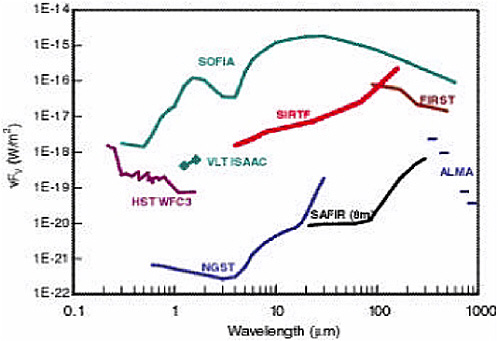
FIGURE 3.2 Relative performance of planned and recommended space initiatives, as well as the performance of the ground-based ALMA in the submillimeter wavelength band. The vertical axis denotes the 5σ flux detectable in 3 hours of integration; therefore better performance is lower on the figure. Estimated performance is based on the combination of photon and confusion noise appropriate to the high-galactic-latitude sky. Courtesy of G. Rieke (University of Arizona) and S. Beckwith (Space Telescope Science Institute).
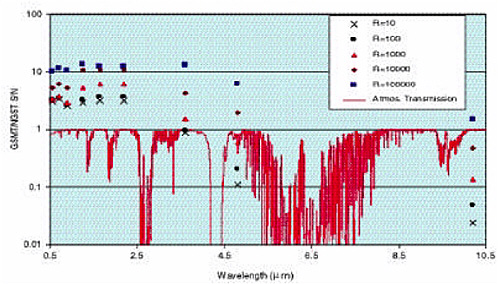
FIGURE 3.3 A comparison of GSMT to NGST for spectral resolving powers of R = 10 through 100,000 over a range of wavelengths. Plotted is the signal-to-noise ratio achieved in an observation of given duration on a given object (much fainter than the sky) for GSMT relative to that achieved with NGST. The comparison shows that GSMT is substantially more effective in obtaining high-resolution spectra of faint objects for short-wavelength radiation that penetrates the atmosphere. NGST is substantially more effective at longer wavelengths, at wavelengths blocked by the atmosphere, and for observations done at low spectral resolution. Courtesy of L. Ramsey (Pennsylvania State University).
optics on ground-based telescopes such as GSMT. GSMT requires a large investment of resources and offers an opportunity for partnership between national and university/independent observatories in producing and operating a world-class facility within the coordinated system of these two essential components of U.S. ground-based astronomy.
Together, NGST and GSMT will trace the formation and evolution of galaxies from the end of the “dark ages,” when the first stars formed, until the present. While NGST’s infrared capability will enable it to study that early epoch of the universe when clouds of hydrogen gas collapsed to form the first galaxies and stars, GSMT will be especially powerful in studying galaxies and intergalactic gas at a somewhat later period of cosmic history when most of today’s stars and chemical elements were formed. NGST will observe the development of the clustering and
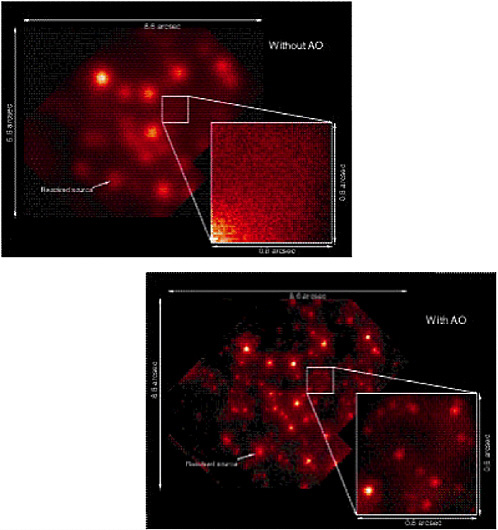
FIGURE 3.4 The power of adaptive optics (AO) as shown by comparison of a high-quality 2.2-µm ground-based image of the galactic center without AO and with AO. Adaptive optics corrects for the distortions caused by the turbulence in the atmosphere and results in an image of much higher resolution (diffraction-limited). Courtesy of the W.M. Keck Observatory Adaptive Optics Team. (This figure originally appeared in Publications of the Astronomical Society of the Pacific [Wizinowich, P., et al., 2000, vol. 112, pp. 315-319], copyright 2000, Astronomical Society of the Pacific; reproduced with permission of the Editors.)
merging of the first galaxies, together with the history of star formation in galaxies. The capabilities of GSMT to study relatively faint sources with high spatial resolution and adequate spectral resolution will provide an essential complement to NGST in understanding how galaxies form and evolve.
GSMT will have the capability of studying the nearest planetary systems and star-forming regions of the Milky Way Galaxy, utilizing high spatial and spectral resolution to directly observe massive planets like Jupiter and to study the innermost regions of protoplanetary disks to ascertain how stars grow and what causes the powerful outflows or winds from young protostars. NGST will be a powerful complement to GSMT in this endeavor by enabling study of the continuum emission from protoplanetary disks, particularly if its spectral imaging capability is extended to the thermal infrared.
These missions address major problems across a broad range of astrophysics. Possible theory challenges for NGST are
 To develop an integrated theory of the formation and evolution of large-scale structure in the universe, Lyman-α clouds, galaxy clusters, and galaxies; and
To understand supernovae—the mechanism of explosion, the spectra, and the light curves.
A possible theory challenge for GSMT is
To develop models of star and planet formation, concentrating on the long-term dynamical co-evolution of disks, infalling interstellar material, and outflowing winds and jets.
Each of these problems requires substantial efforts in numerical simulation as well as in basic theory. The simulations will be particularly valuable in making detailed comparisons of theoretical models with observations.
OPTICAL AND INFRARED SURVEYS: LSST
Telescopes like GSMT and NGST look at selected regions of the sky or study individual sources with high sensitivity. However, another type of telescope is needed to survey the entire sky relatively quickly, so that periodic maps can be constructed that will reveal not only the positions
of target sources, but their time variability as well. The committee recommends the Large-aperture Synoptic Survey Telescope (LSST), a 6.5-m-class very-wide-field (~ 3 deg) telescope that will produce a deep (~ 24th magnitude in a single optical band) digital map of the visible sky every week. Not only will LSST carry out an optical survey of the sky far deeper than any previous survey (see Table 3.1), but it will also add the new dimension of time and thereby open up a new realm for discovery. By surveying the sky each week over a decade, LSST would revolutionize our knowledge of astronomical sources whose light varies on time scales of days to years. Such an experiment could locate 90 percent of all near-Earth objects down to 300 m in size, enable computation of their orbits, and permit assessment of their threat to Earth. It would discover and track objects in the Kuiper Belt, a largely unexplored, primordial component of our solar system. It would discover and monitor a wide variety of variable objects, such as the optical afterglows of gamma-ray bursts. In addition, it would find approximately 100,000 supernovae per year. Analysis of the data on these supernovae would shed light on the distribution of dark matter by determining the peculiar motions of galaxies, and it would provide valuable data on the evolution of stellar populations in galaxies with a wide range of ages. The faintest and most plentiful of this sample of supernovae could be followed up with other ground- or space-based telescopes to study the dynamics of the universe over the last half of its history. LSST would also provide valuable data on steady sources: By adding the data from different nights, it would be possible to develop maps of galaxies down to very faint magnitudes. Such maps would make it possible to infer the structure of dark matter on large scales from the way in which the dark matter distorts the images of the galaxies through weak gravitational lensing. A second-generation instrument with infrared detectors could generate a map of the sky that is 100 times deeper than that obtained with the Two Micron All Sky Survey (2MASS).
With its huge arrays of detectors, LSST will collect more than a trillion bits of data per day, and the rapid data reduction, classification, archiving, and distribution of these data will require considerable effort. The resulting database and data-mining tools will likely form the largest nonproprietary data set in the world and could provide a cornerstone for the National Virtual Observatory (see below). The construction and operation of LSST, together with the processing and distribution of the data, provide critical community service opportunities for an effective national organization for ground-based OIR astronomy.
Possible theory challenges for LSST are
To study the origin and fate of comets and asteroids, and their relation to the building blocks from which planets are formed; and
To discover, interpret, and explain evidence of unexpected rare phenomena buried in the LSST database.
THE TELESCOPE SYSTEM INSTRUMENTATION PROGRAM—TSIP
The committee’s highest priority in the moderate-cost category of either space- or ground-based initiatives is the Telescope System Instrumentation Program (TSIP). Currently available resources for properly instrumenting the suite of 6- to 10-m-class ground-based telescopes (see Table 3.3) are woefully inadequate to fully exploit the potential of facilities available to U.S. astronomers. By substantially increasing the funding of facility instruments for the new generation of large-aperture telescopes at independent and university observatories, the NSF will encourage the continuation of substantial nonfederal investments, leverage their scientific productivity, and add new observing opportunities for the entire U.S. astronomical community. The philosophy of the TSIP is consistent with previous recommendations of A Strategy for Ground-Based Optical and Infrared Astronomy (the McCray report; NRC, 1995), which also recognized the importance of such a program. The TSIP applies to grants exceeding $1 million and does not replace the existing Advanced Technologies and Instrumentation or Major Research Instrumentation programs at the NSF.
-
The committee recommends that, in exchange for TSIP funds, private observatories provide an opportunity to the entire astronomy community to apply for telescope observing time whose value (based on amortized investment and operations) would amount to 50 percent of the granted funds.
The justification for this recommendation is discussed in Chapter 2 of the Panel Reports (NRC, 2001). Through its administration of the TSIP, the NSF can assist national and private observatories in working together as a system so that they can achieve their full scientific potential.
The TSIP will provide the instrumentation and the telescope time to address a number of fundamental problems: for example, the structural
and chemical evolution of galaxies out to redshifts of order 2, the history of star formation as a function of galaxy type and luminosity, the nature of gamma-ray bursts, the evolution of the stellar halo of our galaxy, and the physics of brown dwarfs. Bringing adaptive optics to these telescopes will enable astronomers to monitor changes in the atmospheres of Mars, the Jovian planets, and Titan; to study protoplanetary disks around newly formed stars; and to investigate the structure of active galactic nuclei near their central black holes.
FAR-INFRARED ASTRONOMY FROM SPACE: SAFIR
At wavelengths between 30 µm and 300 µm the atmosphere is so opaque that astronomical observations can be made only from airborne or space-based observatories. Table 3.4 includes the three space missions under construction or in development that cover this wavelength band: the Space Infrared Telescope Facility (SIRTF), the European Far Infrared Space Telescope (FIRST), and the airborne Stratospheric Observatory for Infrared Astronomy (SOFIA). SIRTF and SOFIA should be operational in 2002, whereas FIRST is scheduled to be launched in 2007. SIRTF will make pioneering observations of the infrared emission from young, distant galaxies and will bring tremendous advances in the understanding of brown dwarfs, ultraluminous infrared galaxies, and the dusty disks that surround stars. SOFIA will provide higher-spectral- and higher-spatial-resolution studies of bright SIRTF sources and will make major contributions to research on nearby regions of star formation and the interstellar medium of nearby galaxies.
TABLE 3.4 Existing and Planned Large Space-Based Ultraviolet, Optical, and Infrared Telescopes
|
Project |
Scheduled Years of Operation |
Nations Involved |
Percent U.S. |
Wavelength Banda |
|
HST |
1990 to 2010 |
United States, Europe |
85 |
UV, O, IR |
|
SIRTF |
2002 to 2007 |
United States |
100 |
IR, FIR |
|
SOFIA |
2002 to 2022 |
United States, Germany |
80 |
IR, FIR, SMM |
|
SIM |
2006 to 2011 |
United States |
100 |
O |
|
FIRST |
2007 to 2012 |
Europe, United States |
10 |
FIR, SMM |
|
aFor the purposes of this table, ultraviolet (UV) = 0.1 to 0.3 µm, optical (O) = 0.3 to 1.0 µm, infrared (IR) = 1.0 to 30 µm, far-infrared (FIR) = 30 to 300 µm, and submillimeter (SMM) = 300 µm to 1 mm. |
||||
To take the next step in exploring this important part of the spectrum, the committee recommends the Single Aperture Far Infrared (SAFIR) Observatory, a passively cooled 8-m-class telescope that builds on the technology developed for NGST. As shown in Figure 3.2, SAFIR will be far more sensitive than FIRST, SOFIA, and SIRTF at these wavelengths and will provide 2 to 10 times the spatial resolution of these upcoming missions. The combination of its size, low temperature, and detector capability makes its astronomical capability about 100,000 times that of other missions and gives it tremendous potential to uncover new phenomena in the universe. SAFIR will complement ALMA, NGST, and TPF by providing sensitive coverage of the wavelengths that lie between the capabilities of these missions. A rational coordinated program for space optical and infrared astronomy would build on the experience gained with NGST to construct SAFIR, and then ultimately, in the decade 2010 to 2020, build on the SAFIR, TPF, and SIM experience to assemble a space-based, far-infrared interferometer.
SAFIR will study the birth and evolution of stars and planetary systems so young that they are invisible to optical and near-infrared telescopes such as NGST. Not only does the far-infrared radiation penetrate the obscuring dust clouds that surround these systems, but the protoplanetary disks also emit much of their radiation in the far infrared. Furthermore, the dust reprocesses much of the optical emission from the newly forming stars into this wavelength band. Similarly, the obscured central regions of galaxies, which harbor massive black holes and huge bursts of star formation, can be seen and analyzed in the far infrared. SAFIR will have the sensitivity to see the first dusty galaxies in the universe. For the studies of both star-forming regions in our galaxy and dusty galaxies at high redshifts, SAFIR will be essential in tying together information that NGST will obtain on these systems at shorter wavelengths and that ALMA will obtain at longer wavelengths.
A possible theory challenge for SAFIR is
To understand the origin and evolution of dust in the universe.
INFRARED INTERFEROMETRY FROM SPACE: TPF
The past decade has seen enormous strides in infrared and optical interferometry. The Palomar Testbed Interferometer and the Infrared Spatial Interferometer are in operation now, and the Keck Interferometer, the Center for High Angular Resolution Astronomy Array, the Very
Large Telescope Interferometer (VLT-I), the Large Binocular Telescope (LBT), and the Space Interferometry Mission (SIM) are under development. SIM (see Table 3.4) will be the first space-based interferometer and will demonstrate in space the technique of “nulling” so essential in observing dim planets orbiting bright stars. A particular attraction of SIM is its dual capability: It enables both narrow-angle astrometry for detecting planets and wide-angle astrometry for mapping the structure of the Milky Way and other nearby galaxies. It is critical that an accuracy of a few microarcseconds for wide-angle measurements be achieved in order to address a wide variety of fundamental problems throughout this decade.
These projects lay the groundwork for a truly revolutionary and ambitious mission, the Terrestrial Planet Finder (TPF), which could start before the end of the decade if the precursor missions and technology development proceed successfully and in a timely fashion. As envisioned during the present study, TPF consists of four 3.5-m telescopes, flying in carefully controlled formations spaced tens of meters to 1 km apart, in an orbit far from the heating influence of Earth. Its solar shields will keep the telescope in shadow and will cool it to less than 40 degrees above absolute zero (−390 °F). This low temperature will give it far greater sensitivity than earthbound interferometers in its operating range of 3 to 30 µm. The greatest challenge facing TPF is the capability to enable study of the very faint radiation from an Earth-sized planet against the glare of the central star. Earth radiates roughly a million times less infrared radiation than does the Sun, and when viewed from the nearest star it is only about 1 second of arc in angle (roughly the angle made by a dime seen a mile away) away from the Sun. TPF must also be able to detect planets against the infrared background provided by circumstellar dust (exozodiacal light) in the planetary systems. Large ground-based interferometers such as Keck and LBT can resolve this emission, while SIRTF will survey all the potential TPF targets to levels approaching the strength of the zodiacal emission in the solar system.
TPF has two broad goals. The first is to study planetary systems, especially Earth-sized planets orbiting any of the several hundred nearest stars. The spectrometers on board TPF will analyze the infrared radiation from the planets’ atmospheres and thereby determine their chemical composition. For a small number of the planets, it will search for molecular species such as ozone and methane that might indicate life. The latter observation is so difficult that TPF would require 2 weeks to observe each planet. The discovery of life on another planet is potentially
one of the most important scientific advances of this century, let alone this decade, and it would have enormous philosophical implications.
TPF’s second goal is to study the structure of astronomical sources at infrared wavelengths with unprecedented clarity, at an angular resolution 100 times finer than previously possible. TPF will reveal planets in the process of formation, clearing gaps in dusty protoplanetary disks; individual star formation regions in distant galaxies and in the central regions of galaxies where enormous bursts of star formation occur; and the accretion disks that feed enormous black holes in the centers of galaxies, producing quasars and related active galactic nuclei.
-
To ensure a broad science return from TPF, the committee recommends that, in planning the mission, comparable weight be given to the two broad science goals: studying planetary systems and studying the structure of astronomical sources at infrared wavelengths.
Possible theory challenges associated with TPF are
To understand the formation and evolution of Earth-like planets and their atmospheres; and
To understand the unique objects and processes that occur at the centers of galaxies—stellar collisions, tidal disruption of stars, supermassive black holes, accretion disks, and relativistic jets—and to understand how their interplay leads to the complex phenomena of active galactic nuclei.
The committee notes that TPF requires the following precursor missions for technology development: ground-based OIR interferometers to demonstrate nulling and to measure the exozodiacal light in many nearby star systems; SIM to demonstrate nulling and other interferometric techniques in space; the Space Technology 3 (ST-3) mission to demonstrate formation flying; and NGST to demonstrate passive cooling, infrared detectors, large cryo-optics, and pointing, stability, and vibration control. NASA already has studies under way to determine whether the infrared emission from interplanetary dust will significantly hamper the ability of TPF to detect terrestrial planets. In addition, to ensure that TPF reaches its full scientific potential, it is important to determine prior to the start of the mission the likely probability that there will be an adequate number of Earth-sized planets for TPF to study. TPF will be a significant early step in efforts to learn more about Earth-like planets and whether they harbor life.
ULTRAVIOLET AND OPTICAL ASTRONOMY FROM SPACE
The Hubble Space Telescope has arguably had a greater impact on astronomy than any instrument since the original astronomical telescope of Galileo. Not only has it provided valuable data in virtually every area of modern astronomy, but it has also proved to be a powerful tool for inspiring popular interest in science. The committee endorses the current plans that call for HST to continue operation until the end of the decade, with reduced operating costs after completion of the final servicing mission. Other UVOIR spacecraft now in operation are the Far Ultraviolet Spectroscopy Explorer, which operates in the wavelength range from 0.09 to 0.12 µm, largely below the range of HST, and the Extreme Ultraviolet Explorer, which operates at yet shorter wavelengths. The Galaxy Evolution Explorer, which is in development, will carry out a sensitive survey of the entire sky in the UV, covering the wavelength range from 0.135 to 0.3 µm.
The committee has not recommended any new moderate or major missions for space-based UV or optical astronomy for this decade. This difficult decision was made for several reasons. First, many of the key science opportunities in UVOIR astronomy are predominantly in the infrared: Star and planet formation is best observed in that part of the spectrum because infrared radiation can penetrate the dusty medium in which the stars and planets form, and the first galaxies must be observed in the infrared because their optical and UV light is shifted into the infrared by the expansion of the universe. Second, the infrared region of the spectrum has been studied much less than the optical region, so the potential for discovery is much greater. Finally, much of the important optical astronomy can be done from the ground.
However, it is impossible to observe UV radiation from the ground, and for this decade at least, it will be impossible to carry out diffraction-limited, wide-field imaging in the optical part of the spectrum from the ground. UV observations are essential for tracing the evolution of the intergalactic gas that is too cool to emit x rays, and high-resolution UV spectroscopy is essential to study the dynamics and composition of interstellar gas. Diffraction-limited, wide-field imaging enables a search for sources too faint to be discovered from the ground. To make substantial advances on these questions beyond what can be learned from HST will require a UV-optical space telescope with a spectrometer that delivers a 100-fold increase in throughput and multiplex efficiency. To
prepare the way for such a mission in the decade 2010 to 2020, the committee recommends an aggressive technology development program to develop UV detectors that are more sensitive, energy-resolving detectors such as superconducting tunnel junctions or transition edge sensors, and large, lightweight precision mirrors.
SOLAR ASTRONOMY
The internal structure and dynamics of the Sun, the resulting cyclic and random generation and dissipation of magnetic fields, and the consequent production of the solar wind are of great interest both in their own right and as nearby analogs for key astrophysical processes in more distant objects. In addition, these processes are central to understanding the effect of the Sun on Earth, and as a result they bear on the quest to determine the origin and extent of life in the universe. The study of these processes requires dedicated telescopes equipped with specialized instruments (Table 3.5).
To provide the basis for a broad advance in understanding of the magnetic and hydrodynamic processes that govern the solar surface, the committee recommends three telescopes that monitor different layers of the Sun at wavelengths that include the radio, near infrared, optical, ultraviolet, and soft x-ray. As a complement to these three telescopes, the committee notes that a small initiative to fund the expansion of the Synoptic Optical Long-term Investigations of the Sun (SOLIS) project from a one-station to a three-station network around the globe would permit nearly continuous monitoring of the solar vector magnetic field structure across the surface of the visible Sun over a long time period.
GROUND-BASED SOLAR ASTRONOMY: AST AND FASR
The Advanced Solar Telescope (AST), a 4-m-class solar telescope with adaptive optics operating from 0.3 to 35 µm, is the committee’s top recommendation for solar astronomy. AST will provide a qualitative improvement over the 40-year-old Kitt Peak McMath-Pierce Telescope, which at 1.5 m is currently the largest OIR solar telescope in the world. AST will observe solar plasma processes and magnetic fields with unprecedented resolution in space and time, providing a unique opportunity to probe cosmic magnetic fields and test theories of their generation,
TABLE 3.5 Solar Telescopes
|
Project |
Year(s)a |
Wavelength Bandb |
Commentsc |
|
Ground-based Solar Telescopes |
|||
|
Existing and Approved |
|||
|
Dunn Solar |
1969 |
O, IR |
AO, imaging and spectroscopy |
|
Kitt Peak McMath-Pierce |
1961 |
O, IR |
Largest currently (1.5 m) |
|
Swedish Vacuum Tower |
1985 |
O, IR |
AO |
|
Nobeyama Radioheliograph |
1992 |
R |
2 frequencies |
|
New Initiatives |
|||
|
AST |
2009 |
O, IR |
AO, largest (4 m) |
|
FASR |
2005 |
R |
Multifrequency |
|
SOLIS Expansion |
2004 |
O |
Short-term variability |
|
Space-based Solar Telescopes |
|||
|
Existing and Approved |
|||
|
HESSI (U.S.) |
2000 to 2003 |
G, X |
Solar flares |
|
SOHO (ESA, U.S.) |
1995 to 2006 |
X, EUV, UV, O |
Multipurpose |
|
Solar-B (Japan, U.S., U.K.) |
2004 to 2010 |
X, EUV, UV, O |
Magnetic fields |
|
STEREO |
2004 to 2008 |
O, EUV |
Two small telescopes |
|
TRACE (U.S.) |
1999 to 2004 |
EUV, UV |
SMEX |
|
Yohkoh (Japan, U.S., U.K.) |
1991 to 2003 |
X |
Coronal studies |
|
New Initiative |
|||
|
SDO |
2006 to 2016 |
EUV, UV, O |
Multipurpose |
|
aCommencement of operations for ground-based telescopes, and scheduled years of operation for space-based telescopes. bNotation as in Table 3.4, but with extreme ultraviolet (EUV) = 0.01 to 0.1 µm, x ray (X) = 0.1 to 100 keV, and gamma ray (G) = greater than 100 keV. cAO, adaptive optics; SMEX, small Explorer mission. |
|||
structure, and dynamics. AST will be the first solar telescope large enough to observe structure at the fundamental length scale of 70 km, which is both the pressure scale height and the distance a photon travels before being absorbed or scattered at the solar surface. Many effects and phenomena that are observed on global scales on the Sun and other
stars have their origin in physical processes that occur on this scale, and the Sun is the only star where this scale can be resolved. AST is proposed as a joint project with international partners that will be centered at the National Solar Observatory (NSO). Recent major advances in solar adaptive optics, open-air solar telescopes that provide diffraction-limited images, and large-format infrared cameras make it possible to realize AST in this decade. A theory challenge associated with AST might be
To use powerful three-dimensional magnetohydrodynamic numerical codes to model the solar activity cycle.
The Frequency Agile Solar Radio telescope (FASR) will operate over the broad frequency range from 0.3 to 30 GHz with an angular resolution of 40 to 0.5 arcsec. It will follow the dynamic nature of solar variability at radio wavelengths and probe a range of solar surface layers from the chromosphere to the corona. Its science goals include studying transient energetic phenomena, the coronal magnetic field, and the structure of the solar atmosphere. A possible theory challenge for FASR is
To understand the dynamic transition region and corona of the Sun.
SPACE-BASED SOLAR ASTRONOMY: SDO
The Solar Dynamics Observer (SDO) is recommended to probe more energetic processes on the Sun and to study the region below the solar surface. A successor to the extremely productive Solar and Heliospheric Observatory (SOHO), SDO is a space-based telescope in a geosynchronous orbit that will continuously monitor the Sun in the wavelength band ranging from 0.02 to 1 µm (the extreme ultraviolet to optical part of the spectrum). Many of these wavelengths are obscured by Earth’s atmosphere, and therefore these space observations will provide an essential complement to the observations made by AST from the ground and to other spacecraft (see Table 3.5). SDO will help determine the origin of sunspots and solar active regions, the causes of the emergence and evolution of magnetic fields on the solar surface, the origin of coronal mass ejections and solar flares, and the connections between the interior dynamics and the activity of the solar corona. An understanding of the magnetic processes leading to solar mass ejection and flares, as well as to the generation of slow and fast solar winds, is
critical to investigations of the Sun-Earth connection, including the “space weather” that has a variety of impacts on human activities. A possible theory challenge for SDO is
To model the interaction of turbulent convection and magnetic flux tubes and the interaction and reconnection of magnetic structures.
THE HIGH-ENERGY UNIVERSE
During the period that stars are supported by the heat derived from nuclear fusion, most of the radiation they emit is in the UVOIR part of the spectrum. As in the case of the Sun, however, a small part of the radiation from these stars is in the form of high-energy photons (x rays and gamma rays) produced by magnetic phenomena at the stellar surface. When a star exhausts its nuclear fuel and it is “reborn” as a compact object—a black hole, a neutron star, or a white dwarf—much of the radiation it subsequently emits is in the form of high-energy photons. The formation of a black hole or a neutron star is generally associated with a cataclysmic event such as a supernova or possibly a gamma-ray burst. These events release an enormous amount of gravitational energy, much of which is carried away by energetic neutrinos and, to a lesser extent, by gravitational waves. All these phenomena can result in the production of energetic particles as well. The high-energy universe looks very different from the one we can see in the UVOIR part of the spectrum, and it contains clues that are vital to achieving a comprehensive understanding of the universe.
HIGH-ENERGY PHOTONS: CON-X, GLAST, VERITAS, AND EXIST
Atoms and ions emit and absorb x rays with specific wavelengths or, equivalently, specific photon energies. Gas must be hot, with a temperature exceeding hundreds of thousands of degrees, to emit x rays, but gas and dust can absorb x rays over a wide temperature range. X-ray spectroscopy therefore has the power to reveal the composition of a gas, its temperature and ionization, and (by means of the Doppler shift) its dynamics. As a result, x-ray spectroscopy can tell astronomers when and where elements were formed in the universe, how matter is distributed in clusters of galaxies and the intergalactic medium, and the dynamics of
gas motions in regions around compact objects such as black holes and neutron stars. Not all x rays have energies characteristic of specific atoms or ions, but their spectrum provides clues about the conditions in the gas from which they were emitted.
Constellation-X (Con-X) is the highest-priority large project in highenergy astrophysics. Constellation-X is a system of x-ray telescopes that will go into orbit a million miles from Earth. It will measure the spectra of astronomical objects over the range from 0.25 to 40 keV with a sensitivity far greater than the existing Chandra and X-ray Multi-Mirror (XMM-Newton) missions (Figure 3.5). It achieves this dramatic improvement in sensitivity, or collecting area, by a novel design incorporating four telescopes on four separate but identical spacecraft. This design is more cost-effective than the alternative of building one much larger telescope, and also dramatically reduces the risk. Constellation-X will complement Chandra much as Keck and Gemini complement HST and as GSMT will complement NGST, by obtaining spectra of objects that the smaller telescope can just detect. It will provide an improvement in sensitivity by a factor of 20 to 300 and in spectral resolution by a factor of 3 to 10 compared with Chandra and XMM-Newton. Its timely development is now especially imperative given the tragic loss of the Japanese-U.S. Astro-E mission in February 2000, which would have addressed similar goals at much lower sensitivity. Chandra, on the other hand, can make images with much higher spatial resolution and correspondingly greater positional accuracy than will Constellation-X.
Constellation-X will provide a powerful probe of the hot intergalactic medium, which may contain most of the ordinary matter in the universe. Its spectroscopic capabilities will enable it to trace the evolution of elements heavier than hydrogen and helium over cosmic time. By observing magnetized gas falling into black holes, Constellation-X will probe the properties of spacetime near a spinning black hole, thereby testing strong-field general relativity. Neutron stars, by contrast, have a solid surface and emit x rays in a rich variety of spectral lines. By analyzing the wavelengths, widths, and relative strengths of these lines, it is possible to determine the mass and radius of the star, just as one can with a star like the Sun. This information will ultimately provide a constraint on the behavior of quarks and gluons, the fundamental building blocks of matter, under conditions that cannot be reproduced by particle accelerators.
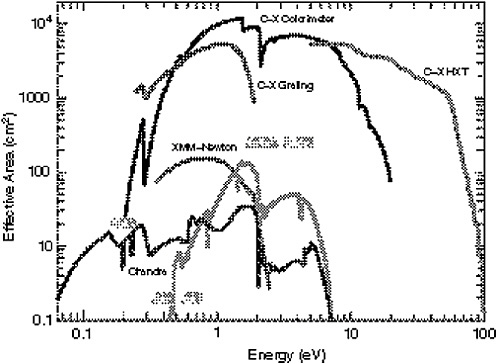
FIGURE 3.5 Comparison of the effective collecting area (equivalent to sensitivity) for x-ray spectroscopy as a function of energy between Constellation-X, Chandra, and XMM-Newton. Note that Constellation-X uses three separate devices to achieve a uniformly large collecting area from roughly 0.25 to 40 keV. The effective areas of the two transmission grating spectrometers on board Chandra are shown in dark blue and light blue. Courtesy of NASA and the Smithsonian Astrophysical Observatory.
Possible theory challenges for Constellation-X are
To develop accurate, documented general-purpose computer codes to model general-relativistic magnetohydrodynamics; and
To understand how the distribution of the elements has evolved over cosmic time.
GLAST and VERITAS. Gamma rays are photons even more energetic than x rays, with energies above a few hundred keV. Some gamma rays have energies characteristic of the nucleus of the atom from which they were emitted; others are produced by electrons that are more energetic than those that produce x rays. Relatively low energy gamma rays must be observed from space, but gamma rays with photon energies
above about 50 GeV can be detected by ground-based telescopes that observe the light generated when the gamma rays strike molecules in the atmosphere. Currently the Energetic Gamma Ray Experiment (EGRET) on the spaceborne Compton Gamma Ray Observatory (CGRO) scans the universe for 0.1- to 10-GeV gamma rays, and the ground-based Whipple Observatory looks for 200- to 3,000-GeV gamma rays. Two specialized Explorer missions, the High Energy Transient Explorer (HETE-2) and Swift, are poised to locate gamma-ray bursts precisely and enable rapid follow-up observations at other wavelengths. Integral, a European mission to be launched in 2001, will measure spectra at photon energies of 20 keV to 10 MeV. None of the existing or planned observatories have the sensitivity to detect very many sources—they are what astronomers call “starved for photons.” The committee recommends two missions to cover the broad band of gamma-ray energies with high sensitivity: the Gamma-ray Large Area Space Telescope (GLAST), for photon energies from 10 MeV to 300 GeV, and the ground-based VERITAS project to cover 50 GeV to 10,000 GeV. For the first time, there will be an overlap in the photon energies detectable from ground and space. GLAST will view a much wider number and variety of sources than VERITAS and is the highest-priority moderate space mission. Figure 3.6 compares the relative sensitivities of GLAST and VERITAS with those of their predecessors, EGRET and Whipple. Improvement by a factor of 10 to 30 in sensitivity means that the number of sources that can be studied improves by a factor of 30 to 150. This increase in sensitivity opens up significant opportunities for new discoveries, particularly when combined with the improved angular resolution these projects provide. GLAST and VERITAS will both address important issues concerning jets from active galactic nuclei, the acceleration of cosmic rays, and the nature of gamma-ray bursts.
A possible theory challenge for both GLAST and VERITAS is
To model the dynamics of and the emission from the relativistic jets that emanate from the vicinity of central black holes in active galaxies.
The Energetic X-ray Imaging Survey Telescope (EXIST) is a specialized survey telescope recommended to study the sky at lower energies (5 to 600 keV). It will perform a survey 1,000 times more sensitive than the previous survey in this energy range, which was done by the High Energy Astronomical Observatory (HEAO-1). Figure 3.6 shows how the EXIST survey will complement those by the Roentgen Satellite (ROSAT),
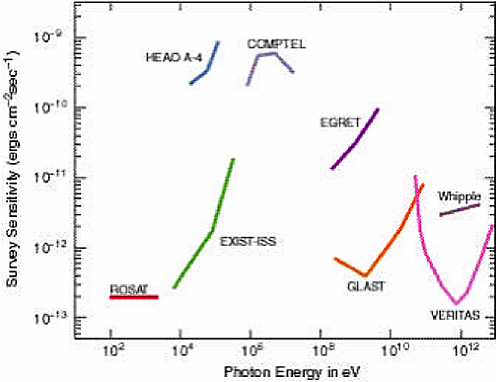
FIGURE 3.6 Limiting fluxes for existing and projected x-ray and gamma-ray surveys as a function of energy. The fluxes assume an energy band equal to the energy, i.e., a broadband measurement. As in Figure 3.2, the better-performing instruments appear lower in the figure. Note the large gains in sensitivity for GLAST, EXIST, and VERITAS. COMPTEL and EGRET are instruments on the Compton Gamma Ray Observatory. Courtesy of L. Bildsten (University of California, Santa Barbara), and NASA.
CGRO, GLAST, and VERITAS. EXIST is a space station-attached telescope with a spectral resolving power of 100 and the ability to locate bright sources to about 30 arcsec. EXIST will survey the entire sky in every 90-minute orbit, which allows the study of the highly time-variable sources that characterize the x-ray sky. It will carry the study of gammaray bursts to lower energies and will be able to study the low-power gamma-ray bursts that appear to be associated with supernovae. Because energetic x rays are so penetrating, EXIST can discover supernovae embedded in molecular clouds and the luminous matter accreting onto supermassive black holes in the centers of galaxies that are obscured at lower photon energies by surrounding gas and dust. Finally, with its ability to perform high-energy-resolution, hard-x-ray spectroscopy of
neutron stars, EXIST will enable astrophysicists to study how radiation interacts with magnetic fields that can be a million to a billion times stronger than can be sustained in the laboratory.
A possible theory challenge for EXIST is
To solve the mystery of gamma-ray bursts.
GRAVITATIONAL RADIATION: LISA
The direct measurement of gravitational waves from astrophysical sources will open new investigations in both astrophysics and the physics of strong gravitational fields. Gravitational waves can probe the dense inner regions of astrophysical systems that are opaque to photons. The committee recommends the Laser Interferometer Space Antenna (LISA), a joint mission between the United States and the European Space Agency, to pioneer the study of low-frequency (periods of 10 to 10,000 seconds) gravitational waves from binary star systems in our galaxy and the coalescence of supermassive black holes. A mission of this type was recommended in the physics survey report Gravitational Physics: Exploring the Structure of Space and Time (NRC, 1999). LISA will complement the ground-based Laser Interferometer Gravitational-wave Observatory (LIGO), which is designed to study the much higher frequency gravitational waves from the coalescence of neutron stars and stellar mass black holes, as well as the core collapse of supernovae. The detection of low-frequency gravitational waves requires a space system with detectors several million miles apart whose separation is monitored with exquisite accuracy, to a precision a thousand times smaller than the size of an atom. Although much progress has been made in the technology for such a mission, including the ground-based laser interferometry for LIGO and the shielding of the reference mass detectors by the space-based Triad and Gravity Probe B programs, a dedicated technology mission in space is envisioned as a precursor to LISA. Three technical areas could benefit from an integrated test on such a precursor: the inertial reference mass, precision thrusters, and high-precision interferometry.
A theory challenge appropriate for LISA would be
To compute the expected gravitational waveforms from black hole mergers.
PARTICAL ASTROPHYSICS
Although most of what we know about the high-energy universe comes from photons, crucial information is also carried by energetic particles—cosmic rays, neutrinos, and, possibly, exotic particles that could constitute much of the mass of the universe, the so-called dark matter. Cosmic rays are relativistic particles accelerated by supernova shock waves and other energetic phenomena. They play an important role in the ionization, heating, and pressurizing of the interstellar medium and in the production of high-energy photons. The typical cosmic ray has an energy of motion comparable to the energy associated with its rest mass, but the most energetic cosmic rays have energies nearly a trillion times greater. The nature and origin of these ultrahigh-energy cosmic rays are not understood. The Southern Hemisphere Pierre Auger Observatory and the high-resolution Fly’s Eye are two ground-based projects that will soon be under way to detect and characterize these ultrahigh-energy cosmic rays. The composition of lower-energy cosmic rays is being studied by the Advanced Composition Explorer, whereas the Antimatter-Matter Spectrometer will search for the presence of antimatter in the cosmic rays.
The committee notes that a proposed small space mission, the Advanced Cosmic-ray Composition Experiment for the Space Station (ACCESS), shows great promise in being able to characterize the mechanism of cosmic-ray acceleration with far greater precision than heretofore possible. A possible theory challenge for ACCESS is
To study the acceleration and propagation of relativistic particles in astrophysics in order to enable accurate comparison between theory and ACCESS observations.
Neutrinos are produced by nuclear reactions in the interior of stars like the Sun, in supernova explosions, and possibly in gamma-ray bursts and in the regions around supermassive black holes. Most existing neutrino detectors are designed to study the relatively low energy neutrinos from the Sun and are focused primarily on studying the physics of neutrinos; as such, they lie outside the purview of this report. Several projects are under way in Europe and in the United States to search for much-higher-energy neutrinos. The U.S. project, AMANDA, uses a huge volume of subsurface ice at the South Pole to detect neutrinos; a much larger follow-on experiment, Ice Cube, has been proposed.
Searches for exotic dark matter particles are also under way or about to begin. In the United States, the Axion experiment is just beginning its search for the “axion” particle, whereas the Cryogenic Dark Matter Search II project promises to be the most sensitive experiment yet to search for the “WIMP” or neutralino particle. These experiments are crucial for astrophysics as well as physics, since our understanding of the universe will be woefully incomplete if we do not comprehend the nature of the dominant form of matter in the universe.
A characteristic of all the projects in particle astrophysics described here, with the exception of ACCESS, is that they are primarily experiments rather than observatories. The nature of experiments means that it is difficult, and likely wasteful, to plan a follow-on experiment without knowing the outcome of the original one. The committee therefore concludes that while particle astrophysics is an exciting and potentially revolutionary field, the decision on whether to proceed with initiatives such as the Northern Hemisphere Auger project/Telescope Array complex and Ice Cube should await the initial outcome of their precursors.
THE RADIO UNIVERSE
Radio waves provide a window onto the origins of the universe, galaxies, stars, and planets that is both unique and complementary to that at other wavelengths. Relic radiation from the Big Bang has been shifted in wavelength by the expansion of the universe to the radio regime, and detected as the cosmic microwave background. Perturbations in this background caused by intervening hot gas in galactic clusters permit radio astronomers to locate these clusters and to view the large-scale structure of the universe. Relativistic particles, spiraling in magnetic fields, emit radio photons and have provided astronomers with the first views of the enormous jets emanating from the vicinities of black holes at the centers of galaxies as well as the high-energy particles accelerated by supernovae. Radio waves offer a clear view of the earliest stages of star and planet formation, which is obscured at many other wavelengths by the surrounding clouds of gas and dust. Radio waves also penetrate Earth’s atmosphere, so that nearly all radio telescopes are ground-based.
CENTIMER-WAVELENGTH ASTRONOMY: EVLA, SKA, AND ARISE
Table 3.6 lists the major centimeter-wavelength observatories accessible to U.S. astronomers. For studying complex or weak, extended sources or problems that require frequency agility or large collecting area, the Green Bank Telescope (GBT) and the newly upgraded Arecibo telescope are unparalleled. The world’s largest steerable antenna, the GBT uses a unique design and active surface control. In addition to being the world’s largest filled aperture, the Arecibo dish can undertake
TABLE 3.6 Large Centimeter-Wave Radio Telescopes with Open Access
|
Project |
Nations Involved |
Aperturea |
Wavelength Range (cm) |
Angular Resolutionb (arcsec) |
|
Existing and Approved |
||||
|
ATCA (ATNF) |
Australia |
6 × 22 m |
0.3 to 20 |
0.1 |
|
Parkes (ATNF) |
Australia |
1 × 64 m |
1.3 to 90 |
50 |
|
Arecibo |
United States |
1 × 300 m |
6 to 90 |
60 |
|
Effelsberg |
Germany |
1 × 100 m |
0.4 to 30 |
10 |
|
GBT |
United States |
1 × 100 m |
0.3 to 150 |
10 |
|
GMRT |
India |
30 × 45 m |
21 to 300 |
2 |
|
HALCA |
Japan, United States |
1 × 8 m |
6 to 20 |
10−3 |
|
1HT |
United States |
500 × 5 m |
3 to 30 |
3 |
|
MERLIN |
United Kingdom |
6 × (25-76) m |
1.3 to 200 |
0.01 |
|
Nançay |
France |
1 × (35 m × 300 m) |
9 to 21 |
100 |
|
VLBA |
United States |
10 × 25 m |
0.4 to 90 |
10−4 |
|
VLA |
United States |
27 × 25 m |
0.7 to 400 |
0.04 |
|
Westerbork |
Netherlands |
14 × 25 m |
6 to 150 |
4 |
|
New Initiatives |
||||
|
EVLA |
United States |
37 × 25 m |
0.7 to 400 |
0.007 |
|
ARISE |
United States |
1 × 25 m |
0.3 to 3 |
10−5 |
|
LOFAR |
Netherlands, United States |
106 m2 |
200 to 1,000 |
1 |
|
Technology Development |
||||
|
SKA |
International |
106 m2 |
|
|
|
aNotation: 6 × 22 m denotes six dishes, each with a diameter of 22 m. Nançay is a single dish but has a noncircular shape. bThe angular resolution shown for HALCA and for ARISE reflects their use in combination with ground-based dishes in an interferometric array. |
||||
radar remote sensing of solar system objects as well as passive radio astronomy. For compact sources, however, it is necessary to use interferometry, a technique pioneered by radio astronomers in which radio signals detected at antennas separated by distances of up to thousands of miles are combined to form an image of the source. The highest resolutions are achievable with the Very Long Baseline Array (VLBA), used to image radio sources associated with quasars, active galactic nuclei (AGNs), molecular masers, and other compact sources. For larger radio sources, however, the Very Large Array (VLA) is the instrument of choice. It provides spatial resolutions of 0.1 to 1 arcsec, comparable to those of the large ground-based optical telescopes. The VLA is the most powerful and productive centimeter-wave telescope in the world, despite the fact that its instrumentation is 25 to 30 years old.
The Expanded VLA (EVLA) is the second priority among major, ground-based projects. The EVLA will have 10 times the sensitivity and angular resolution and 1,000 times the spectroscopic capability of the VLA. The first stage of the expansion will replace instruments, computers, and software and install wideband fiber-optics data links. In the second stage, up to eight new antennas will be sited within 250 km of the VLA and connected via fiber-optics links. The resulting angular resolution of 0.01 to 0.1 arcsec will be comparable to that of ALMA and of NGST, facilitating multi-wavelength studies. These new antennas will also enhance the field of view and sensitivity of the VLBA when the two systems are used together. The committee also notes that a complementary small project, the Low Frequency Array (LOFAR), would extend wavelength coverage to 20 m and provide improvement by a factor of 100 to 1,000 in sensitivity and resolution over existing instruments at these wavelengths. The overall dimension of LOFAR would be several hundred kilometers, possibly using the VLA site as the primary location.
The high angular resolution and sensitivity of the EVLA, combined with the penetrating power of centimeter-wave radio waves, will enable the detailed study of nearby protostars and protoplanetary disks as well as the active nuclei of distant galaxies. The EVLA will produce images of protogalaxies with sufficient detail to determine whether AGN activity associated with a supermassive black hole precedes, is contemporaneous with, or follows bursts of star formation in galactic nuclei.
A possible theory challenge for the EVLA is
To understand the roles of star formation and supermassive black holes in powering luminous active galactic nuclei.
The Square Kilometer Array Technology Development. The EVLA, VLBA, LOFAR, and One Hectare Telescope (1HT), a privately funded array to be used in part for the search for extraterrestrial intelligence (SETI) project, form the foundation of ground-based interferometric centimeter-wave astronomy for this decade. To study how the first galaxies condensed out of vast clouds of atomic hydrogen, a substantially larger radio telescope is needed: the Square Kilometer Array (SKA), with 1 million square meters of collecting area. (By comparison, the EVLA has some 13,000 square meters of collecting area.) The extraordinary sensitivity of SKA will also revolutionize fields of study newly accessible to centimeter-wave astronomy, including the study of jets and the disks of protostars, the measurement of magnetic fields in collapsing clouds, and the study of the distribution of dark matter on the largest scales by means of weak gravitational lensing. The SKA is a major international project that may start in the decade 2010 to 2020. The committee recommends a coherent development program over the current decade to develop the technology that will enable the science objectives to be met at a reasonable cost.
A possible theory challenge for the SKA development is
To understand the formation of the first generation of stars and their effect on reionizing the universe.
The Advanced Radio Interferometry between Space and Earth (ARISE) mission is a 25-m-class space antenna to be linked with the ground-based VLBA. It is recommended as a means of achieving the highest spatial resolution for bright sources such as jets emanating from near supermassive black holes in galactic nuclei. ARISE will operate at wavelengths as short as about 3 mm. Its elliptical orbit will reach up to 50,000 km from Earth, giving an angular resolution six times better than that obtained with the VLBA. It will be an order of magnitude more sensitive than the Japanese HALCA space interferometric system that is currently in operation.
A theory challenge for ARISE might be
To understand maser emission and other physical processes in nonrelativistic accretion disks in our own and other galaxies.
MILLIMETER- AND SUBMILLIMETER-WAVE ASTRONOMY: CARMA AND SPST
Table 3.7 lists the major ground-based millimeter- and submillimeter-wave telescopes in the world. The Atacama Large Millimeter Array (ALMA), an international collaboration among the United States, Canada, Europe, and possibly Japan, will be by far the most powerful of these telescopes when it becomes operational. Situated at a high, dry site in Chile, ALMA will dominate millimeter-wave observations of the southern sky. Under another name (the Millimeter Array), ALMA was the first-ranked radio project a decade ago (NRC, 1991); the committee reaffirms support for this project. The high spatial resolution (as fine as 0.01 arcsec) and sensitivity of ALMA will allow unprecedented views of diverse astronomical phenomena ranging from comets and Kuiper Belt objects in the solar system, to planet-forming disks in nearby regions of star formation, to the structure of the interstellar medium in distant galaxies.
The Combined Array for Research in Millimeter-wave Astronomy (CARMA). The committee recommends support for the construction of a Northern Hemisphere array, somewhat different in design, that will complement ALMA. CARMA would combine nine of the current 6-m Berkeley-Illinois-Maryland Association (BIMA) antennas, the six 10.4-m Owens Valley Radio Observatory (OVRO) dishes, and ten new 2.5-m antennas at a higher and better site in California. The resultant hybrid array would offer unique imaging capabilities to study structure on all scales with particular sensitivity to low-surface-brightness, extended emission. CARMA will be a powerful tool for studying the chemistry, dynamics, and structure in star-forming regions as well as for mapping the deviations in the cosmic microwave background caused by the hot gas in clusters of galaxies. As a project, CARMA is run by a university consortium and is largely funded by nonfederal sources but will provide significant access to the entire astronomical community. It could be undertaken immediately, fostering the training of students and the U.S. capability in millimeter-wave interferometry at the start of the ALMA era and beyond.
The South Pole Submillimeter-wave Telescope (SPST). For its combination of low opacity and stable seeing, the South Pole is the best site in the world for ground-based observations at submillimeter wavelengths. To take advantage of the opportunities offered by this site, the committee recommends the construction there of a 7- to 10-m-class
filled-aperture submillimeter-wave telescope. Such a telescope should be equipped to survey the sky so that it can identify sources such as primordial galaxies, study the distortion of the cosmic microwave background caused by clusters of galaxies, and survey the dusty universe. Its survey capability will make the SPST an important complement to ALMA.
A possible theory challenge for CARMA and SPST is
To understand the dynamical and chemical evolution of molecular clouds in galaxies.
THE COSMIC MICROWAVE BACKGROUND RADIATION
The cosmic microwave background radiation was emitted early in the history of the universe, before stars and galaxies formed. The radiation was emitted with a spectrum dominated by optical and near-infrared radiation, but the expansion of the universe has increased its wavelengths by a factor of about 1,000, so that it is now concentrated in the millimeter and submillimeter parts of the spectrum. When the radiation was emitted, the universe was almost, but not quite, perfectly homogeneous. The small inhomogeneities present at that time were the seeds of the formation of galaxies, clusters of galaxies, and larger structures in the universe. The Cosmic Background Explorer (COBE) was flown in the past decade and made the most precise measurements at that time of the background radiation and the tiny variations in its intensity over the sky (about 1 part in 100,000). Since then, ground- and balloon-based experiments have probed the microwave background on smaller angular scales than did COBE. Recent balloon observations have shown that the total density of matter and energy is just what is needed to make the geometry of the universe flat (see Chapter 2).
Measurements of the microwave background are the primary means available for probing the large-scale structure of the early universe, and as such they are essential for addressing one of the primary science goals for this decade. Scientists’ knowledge of the microwave background will be transformed by ongoing ground-based experiments and by the upcoming Microwave Anisotropy Probe (MAP) MIDEX (mid-size Explorer) mission. The Planck Surveyor, a European-led mission with significant U.S. involvement that is planned for launch in 2007, will study smaller-scale fluctuations in the background. Future microwave background experiments, such as measuring the polarization, are of great importance, but the committee recommends that prioritization of such
TABLE 3.7 Ground-Based Millimeter- and Submillimeter-wave Telescopes
|
Project |
Nations Involved |
Wavelength Band |
Aperturea |
Angular Resolutionb (arcsec) |
|
Existing and Approved Interferometers |
||||
|
ALMA |
United States, Europe, Japan |
Millimeter |
64 × 12 m |
|
|
BIMA |
United Statesc |
Millimeter |
10 × 6 m |
|
|
IRAM |
Europe |
Millimeter |
5 × 15 m |
|
|
Nobeyama |
Japan |
Millimeter |
6 × 10 m |
|
|
OVRO |
United Statesc |
Millimeter |
6 × 10.4 m |
|
|
SMA |
United States, Taiwan |
Submillimeter |
8 × 6 m |
|
|
New Initiative |
||||
|
CARMA |
United Statesc |
Millimeter |
25 × (2.5 to 10 m) |
|
|
Existing and Approved Single Dish |
||||
|
CSO |
United Statesc |
Submillimeter |
10.4 m |
|
|
FCRAO |
United Statesc |
Millimeter |
14 m |
|
|
Hertz (SMT) |
Germany, United Statesc |
Submillimeter |
10 m |
|
|
IRAM |
Europe |
Millimeter |
30 m |
|


|
Project |
Nations Involved |
Wavelength Band |
Aperturea |
Angular Resolutionb (arcsec) |
|
Existing and Approved Single Dish (continued) |
||||
|
JCMT |
United Kingdom, |
Submillimeter |
15 m |
|
|
LMT |
United States,c Mexico |
Millimeter |
50 m |
|
|
Nobeyama |
Japan |
Millimeter |
45 m |
|
|
New Initiative |
||||
|
SPST |
United States |
Submillimeter |
7 to 10 m |
|
|
aNotation: 64 × 12 m denotes 64 antennas with 12-m diameters. bThe wavelength is scaled to the shortest operating wavelength; the number in front of the parenthesis is the angular resolution at that wavelength in arcseconds. cUniversity or private facility in the United States. |
||||


experiments await the results from MAP (assuming it is successful) and the ongoing suite of ground-based and balloon projects.
THE SEARCH FOR EXTRATERRESTRIAL INTELLIGENCE
Are we alone in the universe? Finding evidence for intelligence elsewhere would have a profound effect on humanity. Searching for evidence for extraterrestrial life of any form is technically very demanding, but, as indicated in the discussion of TPF above, there is a clear approach for doing so. The search for extraterrestrial intelligence is far more speculative because researchers do not know what to search for. Radio astronomers have taken the lead in addressing this challenging Netherlands, Canada
problem, and SETI programs are under way at many radio telescopes around the world. This committee, like previous survey committees, believes that the speculative nature of SETI research demands continued development of innovative technology and approaches, which need not be restricted to radio wavelengths. The privately funded 1HT, which will be the first radio telescope built specifically for SETI research, is a good example of such an innovative approach, and it will pioneer new radio techniques that could be used in the SKA.
THE NATIONAL VIRTUAL OBSERVATORY AND OTHER HIGH-LEVERAGE, SMALL INITIATIVES
The National Virtual Observatory (NVO). As the new millennium begins, astronomy faces a revolution in data collection, storage, analysis, and interpretation of large data sets. Data are already streaming in from surveys such as the Two Micron All Sky Survey and the Sloan Digital Sky Survey, which are providing maps of the sky at infrared and optical wavelengths, respectively. The LSST, which will survey the sky every 3 days, will add a third dimension, time, to the data. What is needed is to make the data from all these surveys available to astronomers, educators, and the public so that they can view images of the evolving sky at any wavelength (or color) surveyed by astronomical telescopes. Each day, trillions of bits of information from telescopes will have to be rapidly archived and made available for viewing and analysis. The NVO is designed to enable this, and it is the committee’s highest priority for small projects.
The NVO will link the major astronomical data assets into an integrated, but virtual, system to allow automated multiwavelength search and discovery among all cataloged astronomical objects. The computers used in the NVO would be distributed across the country, but high-speed networks would link them into a unified system. The NVO not only would archive the data but also would provide advanced analysis services for the astronomical community, create data standards and tools for mining data, and provide a link between the exciting astronomical data and the educational system in the United States. The opportunities for communicating the most recent discoveries in the dynamic sky into
classrooms and homes worldwide give the NVO the potential of becoming a powerful tool for increasing the general public’s science literacy.
Theoretical Astrophysics. All the major and moderate programs recommended in this report are aimed at making substantial advances in astronomers’ ability to observe the universe. However, these data would have little significance in the absence of a theory to interpret them. Theorists play a major role in defining the intellectual frontier of astronomy and astrophysics, in developing the models that quantitatively relate observational data to the underlying physics and chemistry, and in synthesizing a world view that is accessible to the general public. In view of the explosion in the rate of astronomical discoveries, the committee believes that the resources recently devoted to theory are not adequate for an optimized program, and it therefore recommends three small initiatives to redress this imbalance: (1) Theory challenges tied to major and moderate projects. These challenges should be administered as a competitive grants program that is budgeted and programmed as an integral part of its associated project. Examples of possible theory challenges are given above. Each challenge should identify a theoretical problem that is ripe for progress, relevant to the planning and design of the mission, and essential to the interpretation and understanding of its results in the broadest context. Funding for this program might typically amount to 2 to 3 percent of the cost of the project, although this amount could vary substantially depending on the nature of the project. (2) The National Astrophysical Theory Postdoctoral Program modeled on the highly successful Hubble postdoctoral program. Currently, grants to individual theorists rarely have the funding or the longevity to support postdoctoral fellows. A national postdoctoral program in theoretical astrophysics will support innovative research by the new generation, foster their intellectual development, and encourage ethnic and gender diversity. This program should be supported jointly by NASA and NSF to provide 10 new 3-year postdoctoral positions each year. (3) Augmentation of the Astrophysics Theory Program at NASA. This program has been highly successful, but the report Federal Funding of Astronomical Research (NRC, 2000) documents the difficulties facing it—the 3-fold oversubscription in 1987 increased to oversubscription by a factor of 4.8 in 1997, and the overall funding for theory declined by about 20 percent from 1990 to 1999. The committee recommends that the Astrophysics Theory Program be augmented by $3 million per year to bring it into better balance with the vigorous experimental and observational pro-
grams at NASA. More details on these recommendations can be found in Chapter 1 of the Panel Reports (NRC, 2001). These three programs should not divert funds from existing grants programs for broadly based theory.
Laboratory Astrophysics. Existing missions and facilities are returning spectroscopic data of unprecedented breadth and detail, yet in many cases these data cannot be interpreted because the underlying atomic and molecular properties are unknown. Even in the Sun, almost 40 percent of the coronal lines observed by SOHO in the range from 50 to 160 nm are unidentified; for those lines that are identified, the wavelengths and excitation cross sections may be so poorly known that quantitative interpretation of the data is impossible. Existing missions such as Chandra and XMM-Newton and proposed missions such as NGST, Constellation-X, and SAFIR will obtain spectra of much more exotic objects where the uncertainties are much greater. In addition to atomic and molecular physics, the properties of irradiated ices, refractory grains, and fluids at high energy densities also require study. At present, support from both NASA and NSF for these types of investigations is extremely limited. The committee recommends a significant increase in support for these areas, primarily from NASA, since the largest residual uncertainties in the atomic and molecular databases pertain to transitions that lie primarily in wavelength bands accessible only from space. Specifically, the committee recommends a dedicated NASA grants program for laboratory astrophysics funded at the level of $4 million per year ($40 million for the decade), which should enable roughly 8 to 10 significant experimental programs that collectively cover most of the spectrum. The committee also recommends a smaller level of support from NSF ($500,000 per year or $5 million for the decade) that would be directed at computational atomic and molecular physics and database development.
In addition to the above recommended initiative for laboratory astrophysics, the committee notes several proposed programs that will provide significant benefit to astrophysics. Direct laboratory simulation of magnetic reconnection in plasmas and of radiative-hydrodynamical instabilities in supernovae and supernova remnants have the potential to be of great benefit in interpreting astronomical observations, particularly when coupled with computational modeling of the same phenomena. Better knowledge of key nuclear reaction rates is essential for advancing scientists’ understanding of the late stages of stellar evolution, of supernovae, and of Big Bang nucleosynthesis. Finally, experiments at the Relativ-
istic Heavy Ion Collider and the Large Hadron Collider will determine the properties of the quark-gluon plasmas that existed a few microseconds after the Big Bang.
Ultralong-Duration Balloons (ULDBs). NASA’s Explorer program has been extremely successful because it provides frequent access to space for innovative projects across the entire field of astrophysics. In many cases, most of the advantage gained by going into a low Earth orbit could be achieved at far less cost with balloons capable of remaining aloft for periods of 100 days or more. Examples of the kind of science that can be carried out with balloons include searches for planets with a coronagraph on a diffraction-limited telescope a few meters in diameter, imaging convective flows and magnetic fields in the Sun’s photosphere with a large solar telescope, extragalactic observations with a moderate-sized far-infrared telescope, or all-sky surveys at hard x-ray wavelengths. The top of the stratosphere is far superior to terrestrial sites and enables a wide range of small-mission science at wavelengths not transmitted to Earth.
The committee recommends that NASA invest the necessary resources (estimated to be about $35 million) to develop steerable ULDBs, and that use of ULDBs be allowed as an alternative to spacecraft (where warranted) in all Explorer programs.


