
A VISION FOR ASTRONOMY AND ASTROPHYSICS IN THE NEW CENTURY
In the year 1000 AD there were astronomers in only a few places on Earth: in Asia, particularly China, in the Middle East, and in Mesoamerica. These astronomers were aware of only six of the nine planets that orbit the Sun. Although they studied the stars, they did not know that the stars were like the Sun, nor did they have any concept of their distances from Earth. By the year 2000 AD, humanity’s horizons had expanded to include the entire universe. We now know that our Sun is but one of 100 billion stars in the Milky Way Galaxy, which is but one of about 100 billion galaxies in the visible universe. More remarkably, our telescopes have been able to peer billions of years into the past to see the universe when it was young—in one case, when it was only a few hundred thousand years old. All these observations can be interpreted in terms of the inflationary Big Bang theory, which describes how the universe has evolved since the first 10−36 seconds of cosmic time.
It is impossible to predict where astronomy will be in the year 3000 AD. But it is clear that for the foreseeable future, the defining questions for astronomy and astrophysics will be these:
-
How did the universe begin, how did it evolve from the soup of elementary particles into the structures seen today, and what is its destiny?
-
How do galaxies form and evolve?
-
How do stars form and evolve?
-
How do planets form and evolve?
-
Is there life elsewhere in the universe?
Researchers now have at least the beginnings of observational data that are relevant to all of these questions. However, a relatively complete answer exists for only one of them—how stars evolve. The development and observational validation of the theory of stellar evolution was one of the great triumphs of 20th-century astrophysics. For the 21st century, the long-term goal is to develop a comprehensive understanding of the formation, evolution, and destiny of the universe and its constituent galaxies, stars, and planets—including the Milky Way, the Sun, and Earth.
In order to do this, the committee believes that astronomers must do the following:
-
Map the galaxies, gas, and dark matter in the universe, and survey the stars and planets in the Galaxy. Such complete surveys will reveal, for example, the formation of galaxies in the early universe and their evolution to the present, the evolution of primordial gas from the Big Bang into matter enriched with all the elements by stars and supernovae, the formation of stars and planets from collapsing gas clouds, the variety and abundance of planetary systems in the Galaxy, and the distribution and nature of the dark matter that constitutes most of the matter in the universe.
-
Search for life beyond Earth, and, if it is found, determine its nature and its distribution in the Galaxy. This goal is so challenging and of such importance that it could occupy astronomers for the foreseeable future. The search for evidence of life beyond Earth through remote observation is a major focus of the new interdisciplinary field of astrobiology.
-
Use the universe as a unique laboratory to test the known laws of physics in regimes that are not accessible on Earth and to search for new physics. It is remarkable that the laws of physics developed on Earth appear to be consistent with phenomena occurring billions of light-years away and under conditions far more extreme than those for which the laws were derived and tested. However, researchers have only begun to probe the conditions near the event horizons of black holes or in the very early universe, where the tests of the laws of physics will be much more stringent and where new physical processes may be revealed that shed light on the unification of the forces and particles of nature.
-
Develop a conceptual framework that accounts for all that astronomers have observed. As with all scientific theories, such a framework must be subject to continual checks by further observation.
For the new decade, astronomers are poised to make progress in five particular areas:
-
Determining the large-scale properties of the universe: its age, the nature (amount and distribution) of the matter and energy that make it up, and the history of its expansion;
-
Studying the dawn of the modern universe, when the first stars and galaxies formed;
-
Understanding the formation and evolution of black holes of all sizes;
TABLE 2.1 Science Goals for the New Initiatives
|
|
Initiativea |
|
|
Science Goal |
Primaryb |
Secondaryb |
|
Determining large-scale properties of the universe |
NGST, GSMT, LSST (MAP, Planck, SIM) |
Con-X |
|
Studying the dawn of the modern universe |
NGST, SKA, LOFAR (ALMA) |
Con-X, EVLA, SAFIR, GLAST, LISA, EXIST, SPST |
|
Understanding black holes |
Con-X, GLAST, LISA, EXIST, ARISE |
EVLA, LSST, VERITAS, SAFIR |
|
Studying star formation and planets |
NGST, GSMT, EVLA, LSST, TPF, SAFIR, TSIP, CARMA, SPST (ALMA, SIM, SIRTF, SOFIA) |
AST, SDO, Con-X, EXIST |
|
Understanding the effects of the astronomical environment on Earth |
LSST, AST, SDO, FASR |
GLAST |
|
NOTE: Acronyms are defined in the appendix. aMissions and facilities listed in parentheses are those that were recommended previously but have not yet begun operation. bProjects or missions listed in the “primary” category are expected to make major contributions toward addressing the stated goal, while “secondary” projects or missions would have capabilities that address the goal to a lesser degree. |
||
-
Studying the formation of stars and their planetary systems, and the birth and evolution of giant and terrestrial planets; and
-
Understanding the effects of the astronomical environment on Earth.
Table 2.1 lists these science goals and the new initiatives that will address them.
In addition, the time is ripe for using astronomy as a gateway to enhance the public’s understanding of science and as a catalyst to improve teachers’ education in science and to advance interdisciplinary training of the technical work force.
THE FORMATION AND EVOLUTION OF PLANETS
The discovery of extrasolar planets in the past decade was one of the most remarkable achievements of the 20th century and represented the culmination of centuries of speculation about planets orbiting stars other than our Sun. These observations confirmed for the first time that a significant fraction of the stars in the Milky Way Galaxy have planetary systems; at the same time, the observations brought the surprising news that a number of planetary systems are very different from our solar system. In fact, the first extrasolar planetary system discovered is quite exotic: Although it involves terrestrial-mass planets, the central star is not a normal star like the Sun, but a rapidly spinning neutron star. The first planet detected around a Sun-like star is much more massive than Earth. Its mass is at least half that of Jupiter, the largest planet in the solar system, but its orbit is only one-tenth as large as that of the innermost planet, Mercury (Figure 2.1). Further discoveries indicate that such “hot Jupiters”—gas giant planets orbiting 100 times closer to the host star than their analogs in our own solar system—are surprisingly common, being found around a few percent of all solar-type stars. It may even be that our own planetary system is the exception and hot Jupiters the rule.
We are witnessing the birth of a new observational science of planetary systems. The new measurements of masses and orbital distances of planets demand explanation. The first step is to carry out a census of extrasolar planetary systems in order to answer the following questions: What fraction of stars have planetary systems? How many planets are there in a typical system, and what are their masses and distances from the central star? How do these characteristics depend on the mass of the star, its age, and whether it has a binary companion?
Astronomers have a number of methods to detect extrasolar planets: astrometry, measurement of Doppler shifts, photometry, observations of gravitational microlensing, and direct imaging. SIM will utilize astrometry, a method that uses the back-and-forth motion of stars in the sky to infer the presence of an orbiting planet, to increase the census of Jovian-mass planets orbiting at relatively large distances from their central stars. GSMT and other ground-based telescopes will measure small shifts in the wavelengths of the observed radiation, or the Doppler shifts, caused by the motion of stars toward and away from us as the planets orbit the stars. The Doppler method has been used almost exclusively in the past decade and favors small orbital separation and
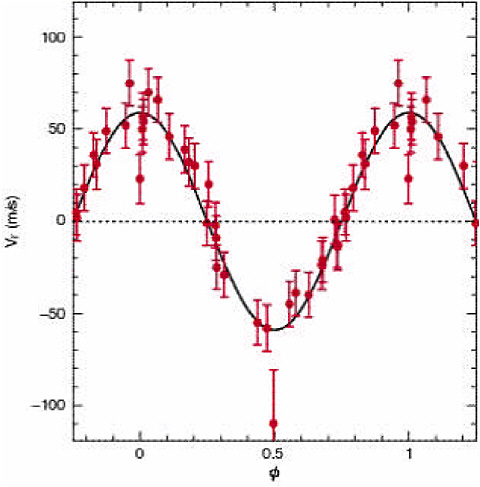
FIGURE 2.1 The discovery of the first planet orbiting a Sun-like star outside the solar system was made by observing small oscillations in the radial velocity Vr of the star 51 Pegasi. These oscillations are caused by the planet as it orbits the star every 4.2 days. The phase  represents the time in units of the 4.2-day cycle. Courtesy of M. Mayor, D. Queloz, and S. Udry (Universite de Geneve). Reprinted by permission from Nature 378:355-359, copyright 1995 Macmillan Magazines Ltd.
relatively large planets. Photometry measures the small decrease in the light from a star when a planet orbits between the observer and the star, partially eclipsing the star. Because photometry depends on a favorable inclination of the orbit, surveys of a large number of stars are required to find the frequency of planetary systems. Space-based photometry is sufficiently precise that it could extend the census to planets with masses as low as those of the terrestrial planets. Sensitive photometry of distant stars can also reveal planets through gravitational microlensing: The
gravitational field of an intervening faint star close to the line of sight to a distant star acts as a lens that amplifies the light of the distant star; planets orbiting the intervening star can change the amplification in a detectable manner. However, these methods all detect planets indirectly by their small perturbations of the light from the central star. The ultimate goal is to see and study the radiation from the planets themselves. Direct imaging of giant planets can be done from the ground with adaptive optics, but TPF or an enhanced NGST is needed for terrestrial planets.
Once direct imaging is possible, radiation from extrasolar planets can be analyzed to characterize the atmospheres of the planets: How do the atmospheres depend on the mass of the planet, its separation from its host star, and the mass of the host star? Do any of the planets appear habitable? Are there any biological “marker materials” such as methane, molecular oxygen, or ozone? Observation of the atmospheres is extremely challenging, owing to confusion with the enormously brighter host star. TPF is designed to address this problem by using interferometry to null out the radiation from the host star; with the addition of an occulter NGST may contribute to this goal.
The planetary census, together with new observations of protoplanetary disks, will provide the data needed to understand planet formation. Observations over the past two decades have established that protostars are accompanied by disks of gas and dust. These disks are believed to feed the growth of the stars and are regions where planets could form. Today’s instruments do not have the resolution or the sensitivity to find evidence for the existence of planets in protostellar disks, but ALMA, NGST, and TPF will. Theory shows that gas giants should create gaps in the disks that will be readily observable by these powerful instruments. Young giant planets (≤10 million years old) will emit enough radiation in the near infrared to be detectable by both NGST and GSMT in the nearby molecular clouds where star formation is occurring. These observations will reveal how protostellar disks evolve and the conditions under which planets can form. The existing census of extrasolar planets already indicates a surprising number of massive planets orbiting extremely close to the central star. Are these planets formed in the outer regions of the disk and then pushed into tighter orbits by the gravitational interaction with the disk material or with other planets? The Sun is in the minority in not having a stellar companion. Now do companion stars affect planet formation? Most stars form in large clusters containing massive stars, such as the cluster associated with the Trapezium in Orion. What is the effect of such an environment on
planet formation? Hubble pictures showing the destruction of protostellar disks in the Orion Nebula (Figure 2.2) suggest that such an environment is very hostile to planet formation.
Some recent discoveries within our own solar system point the way toward another approach to filling in some details of the picture of planet formation and evolution. The Kuiper Belt consists of a ring or disk of subplanetary bodies circling the Sun beyond Neptune. Some 200 Kuiper Belt objects (KBOs) are now known, with diameters mostly in the 100- to 800-km range (Figure 2.3). Smaller KBOs are too faint to have been detected in existing surveys; larger ones almost certainly exist but await detection by deep, all-sky surveys such as will be conducted by LSST. It is thought that as many as 10 more objects of Pluto size (with a diameter of 2,000 km) await discovery. These KBOs are but the tip of an iceberg. Probably 100,000 objects larger than 100 km exist at distances 30 to 50 times Earth’s distance from the Sun. The number of objects larger than 1 km lies in the range of 1 billion to 10 billion. These objects are fossil remnants of the Sun’s planetary accretion disk, and their motions provide direct evidence of the protoplanetary disk’s physical characteristics. Collisions between these objects provide a long-term source for tiny dust particles in the solar system. Similar dust disks have been detected recently around some other main-sequence stars. The Kuiper Belt is probably the source of most short-period comets. Near-infrared spectra of the KBOs capitalizing on the huge light-collecting capability of GSMT will, for the first time, reveal the composition of comets in their pristine state, prior to entry into the inner solar system.
The atmospheres of planets can be studied primarily in our own solar system. Except for Uranus, the gas giant planets emit more energy than they receive from the Sun. Their internal heat production drives complex and poorly understood systems of convection. The main external manifestations include differential rotation (as in the Sun) and energetic, weather-like, circulation patterns at the visible cloud tops. Planetary convection also powers dynamo action, causing the gas giants to support huge radio-bright magnetospheres. New adaptive optics systems on large-aperture telescopes will provide 10-milliarcsec resolution in the near infrared (Figure 2.4), enabling the study of long-term changes in planetary circulation (at Jupiter, 10 milliarcsec = 35 km; at Neptune, 200 km). Such studies will also provide the context for in situ investigations by NASA spacecraft.
Near-Earth objects (NEOs) are asteroids with orbits that bring them close to Earth. The orbits of many NEOs actually cross that of Earth,
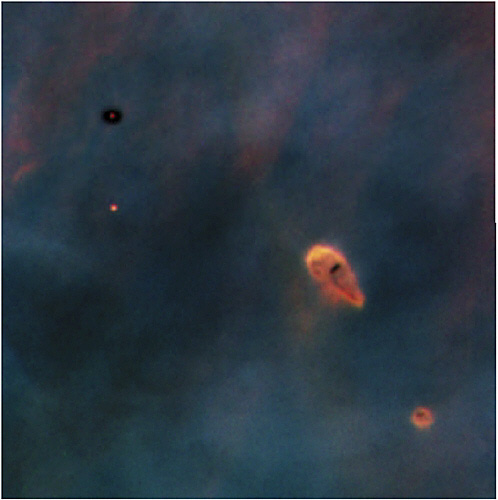
FIGURE 2.2 Protoplanetary disks in the Orion Nebula. These dark silhouetted disks, sometimes surrounded by bright ionized gas flows as seen in the cometary shape above, are being destroyed by intense ultraviolet radiation from nearby massive stars. The rapidity of their destruction may interrupt planet formation in these disks. Courtesy of C.R. O’Dell (Rice University) and NASA.
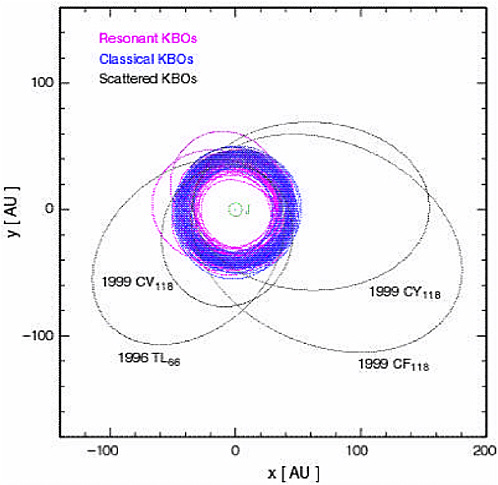
FIGURE 2.3 Plan view of the solar system, showing the orbits of the 200 Kuiper Belt objects (KBOs) known as of October 1999. Red orbits denote KBOs in orbits that are in resonance with Neptune, including Pluto; blue orbits show nonresonant or “classical” KBOs; and the large, eccentric orbits with labels denote KBOs that have been scattered by the gravity of the giant planets. The orbit of Jupiter at 5 AU (AU = astronomical unit, the distance from Earth to the Sun) is shown for scale. Observations with LSST should increase the number of known KBOs to 10,000, permitting intensive investigation of the dynamical structure imprinted on this fossil protoplanetary disk by the formation process. Courtesy of D. Jewitt (University of Hawaii).
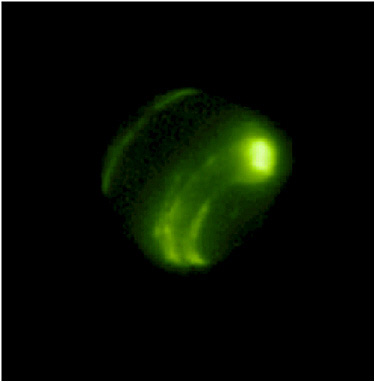
FIGURE 2.4 An image of Neptune taken by the Keck Adaptive Optics Facility in the methane absorption band at 1.17 µm. The angular resolution of this image is approximately 0.04 arcsec, about an order of magnitude better than the resolution obtained without adaptive optics. Courtesy of the W.M. Keck Observatory Adaptive Optics Team. (This figure originally appeared in Publications of the Astronomical Society of the Pacific [Wizinowich, P., et al., 2000, vol. 112, pp. 315-319], copyright 2000, Astronomical Society of the Pacific; reproduced with permission of the Editors.)
making NEOs an impact threat to our planet. Extrapolations from existing data suggest that about 1,000 NEOs are larger than 1 km in diameter, and that between 100,000 and 1 million are larger than 100 m. The effects of past NEO impacts on Earth range from the destruction of hundreds of square miles of Siberian forest at Tunguska in 1908 by a relatively small NEO to substantial disruption of the biosphere at the end of the Cretaceous period some 60 million years ago by a large (10-km) NEO. Interplanetary space is vast, so the probability of a substantial NEO hitting Earth is small: For example, it is estimated that the probability that an NEO larger than 300 m will strike Earth during this century is about 1 percent. Nonetheless, it behooves us to learn much more about these objects. Over a decade, LSST will discover 90 percent of the NEOs larger than 300 m, providing information about the origin of these objects in the process. However, comets also pose a substantial impact hazard, as was dramatically illustrated by the impact of Comet Shoemaker-Levy on Jupiter (Figure 2.5). Although LSST will discover much about comets, it will not provide long-term warning of potentially hazardous long-period comets.
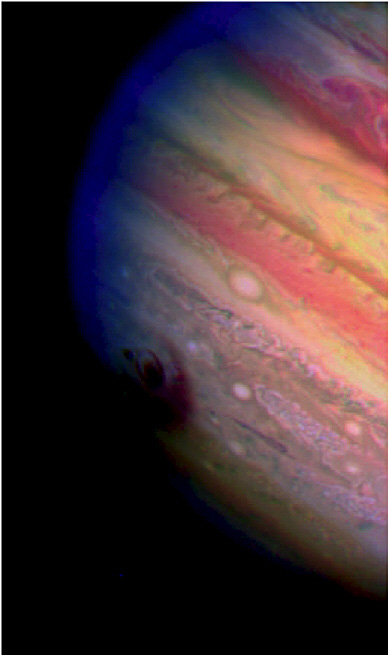
FIGURE 2.5 The impact of fragment “G” of Comet Shoemaker-Levy 9 onto Jupiter in July 1994 left dark rings of substantially altered atmosphere (lower left section of the planet). The thick dark outermost ring’s inner edge has a diameter about the size of Earth’s. The impact had an explosive energy equivalent to roughly a million megatons of TNT. Courtesy of H. Hammel (Massachusetts Institute of Technology) and NASA.
STARS AND STELLAR EVOLUTION
The development and confirmation of the theory of the structure and evolution of stars represent one of the great achievements of 20th-century science. Stars are the building blocks of galaxies and are the “atoms” of the universe. Essentially all the elements in our bodies except hydrogen were created in the nuclear fires in stellar interiors. The discovery in the past decade of “brown dwarfs,” stars too small to burn hydrogen, has extended the range of stellar masses over which the theory applies. Despite the great success of this theory, it has a gaping hole: It neither predicts nor explains how stars form. Such knowledge is critical for understanding not only how planets form, but also how systems of stars, such as galaxies, must evolve.
STAR FORMATION
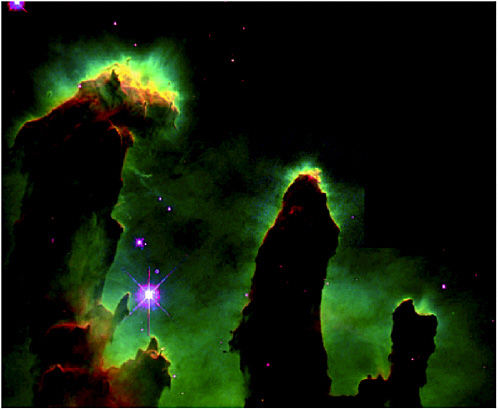
Star formation proceeds in the densest regions of opaque clouds of gas and dust that are scattered throughout the interstellar medium of a galaxy (Figure 2.6). Most of the gas in these clouds is molecular, and it is highly inhomogeneous. Stars form in the densest parts of molecular clouds when the mutual gravitational attraction of the gas overcomes the thermal pressure, turbulent motions, and magnetic fields that support the cloud. The ensuing collapse forms a single star, a binary, or less often, a multiple-star system. Theory suggests, and observations confirm, that most stars are encircled by disks when they first form. These disks are the birthplaces of planets. As stars grow by accretion of material from their disks, powerful bipolar winds are created perpendicular to the disks. These winds interact strongly with the infalling material and the natal molecular cloud. The mass of a star is the primary determinant of its characteristics over most of its life, yet researchers do not know what determines the star’s birth mass. There are many other important unsolved problems in star formation as well, including understanding how molecular clouds form in the interstellar medium, how these clouds evolve to form protostellar cores, what tips the scales in favor of gravitational collapse, what determines when binaries form, how stars form in clusters, and how protostellar winds affect star formation.
From a theoretical perspective, studying star formation is challenging because it requires following the evolution of matter from the very tenuous gas in the interstellar medium, where densities are measured in the number of particles per cubic centimeter, to stellar interiors, where
the densities are measured in grams per cubic centimeter—a trillion trillion times greater. Nevertheless, considerable progress has been made toward developing a theory, particularly for isolated stars with masses similar to that of the Sun. Numerical simulation on supercomputers is playing an important role in this effort. Theories of massive star formation are less advanced because of the strong interaction of the radiation from these luminous stars with the infalling gas and dust. The theory of star formation in clusters is similarly primitive because of the complicated interaction of the cores and protostellar winds in these regions.
From an observational perspective, star formation is challenging because dust obscures the regions of star formation, rendering them largely invisible to optical telescopes. Observation of the formation of massive stars is even more challenging since the sites of massive-star formation are rare and therefore on average more distant; furthermore, recent observations show that they are obscured by even more dust than are the regions of low-mass star formation. Infrared, submillimeter, millimeter, and hard x-ray radiation penetrate the obscuring dust; in addition, the gas and dust that form stars, disks, and planets radiate primarily at infrared and longer wavelengths. The substantial improvements in sensitivity and spatial resolution at these wavelengths obtained with many of the recommended new initiatives, together with facilities now under development, should lead to great advances in solving the important problems in star formation (see Table 2.1).
THE SUN
As the nearest star, the Sun provides us with the opportunity to test with exquisite accuracy our understanding of stellar structure. Using a powerful combination of theory and observation, solar physicists have done just that over the past decade: By studying tiny oscillations in the Sun (a technique termed “helioseismology”), they have shown that theoretical models for the internal structure of the Sun are accurate to within about 0.1 percent. Solar models are sufficiently accurate that the Sun can now be used as a well-calibrated source of neutrinos to carry out investigations of the basic physics of these fundamental particles.
Although understanding of the equilibrium properties of the Sun has been validated by helioseismology, understanding of the nonequilibrium properties—associated primarily with magnetic fields—remains poor. Magnetic fields play a crucial role in astrophysical phenomena ranging
from the formation of stars to the extraction of energy from supermassive black holes in galactic nuclei. The Sun provides a natural laboratory for the study of cosmic magnetism on scales not accessible on Earth and not resolvable in distant astronomical objects (see Figure 2.7). Solar magnetic fields lead to “space weather,” which can destroy satellite electronics and disrupt radio communications. These fields are also believed to be responsible for the variations in the Sun’s luminosity that lead to variations in Earth’s climate on a time scale of centuries. Such climate variations have undoubtedly influenced the evolution of life on Earth. Other stars are observed to have larger variations in their luminosity, which could have a correspondingly stronger effect on any life that might exist on planets in those systems.
The first scientific goal for advancing the current understanding of solar magnetism is to measure the structure and dynamics of the magnetic field at the solar surface down to its fundamental length scale. This length scale is believed to be determined by the pressure scale height, which is about 70 km, or 0.1 arcsec in angle from Earth; numerical simulations suggest that the size of magnetic flux tubes might be about half this. AST is designed to achieve this angular resolution. With the collecting area of a 4-m mirror, it will also have sufficient sensitivity to measure weak magnetic fields on this scale at the requisite time resolution. AST will permit substantial progress in the understanding of the physical processes in sunspots. At night, AST will obtain complementary information on the role of stellar magnetic fields by observing other stars, which can behave quite differently from the Sun. Constellation-X will contribute to these studies by providing accurate measurements of physical conditions in the coronae of other stars.
The second scientific goal is to measure the properties of the magnetic field throughout the entire solar volume, extending from below the surface out to 18 solar radii. Below the visible surface of the Sun, magnetic fields are trapped in the solar gas and move with it. The turbulent convection and the apparently random emergence of magnetic fields cause surface magnetic fields to be mixed on a range of scales. An important development of the past decade was the use of acoustic tomography to create three-dimensional maps of these field structures. Above the surface, in the solar corona, the gas density drops very rapidly and the situation is reversed: There, the highly conducting solar gases are forced to move with the magnetic fields, so that the entire outer atmosphere responds continuously to the motions of the footpoints of the magnetic field trapped in the surface. Extreme ultraviolet measurements
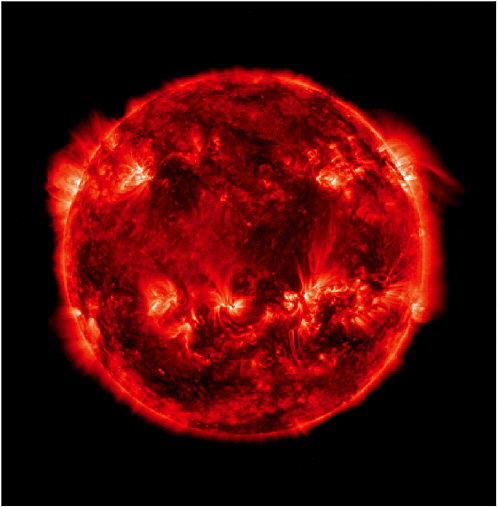
FIGURE 2.7 An image of the full disk of the Sun at x-ray wavelengths (0.0171 µm), which are sensitive to the emission from a highly ionized iron atom (eight electrons removed). This emission arises from gases with temperatures between 600,000 and 1 million K. The image is a photomosaic of 42 overlapping 8.5 by 8.5 arcsec images taken by the TRACE spacecraft. Courtesy of NASA and the Stanford-Lockheed Institute for Space Research.
made by the TRACE spacecraft have shown that as a result, coronal structures are rapidly evolving and highly inhomogeneous, with loops at 30,000 K adjacent to loops at 3 million K (see Figure 2.7). When regions with opposite polarity collide, the overlying magnetic fields reconnect and restructure. These processes release enormous amounts of energy that are responsible for the heating of the outer solar atmosphere, flares, coronal mass ejections, and the acceleration of the solar wind toward Earth. SDO, which combines observations of the subsurface, surface, and corona, is designed to collect data to answer fundamental questions about the interaction of gas flows and magnetic fields, reconnection and restructuring of magnetic fields, rapid energy release processes, and outward acceleration of solar material.
Together, AST and SDO will provide a comprehensive view of the dynamics of the solar magnetic field and lead to a much deeper understanding of cosmic magnetism. In addition, these projects will revolutionize our understanding of space weather and global change, which are influenced by the Sun because Earth and the space surrounding it are bathed by the Sun’s outer atmosphere.
STELLAR METAMORPHOSIS
Most living things slow down as they age and eventually cease to be able to generate new life. Stars behave in the opposite fashion: Evolution accelerates when they near the end of their lives as normal stars, and during the final stages a significant fraction of their mass, enriched with heavy elements generated in their interiors, is dispersed into surrounding space (Figure 2.8). The ejected gas, mixed with the local interstellar medium, can then be recycled to form new stars and planetary systems. Left behind is a compact stellar remnant—a white dwarf, with a radius 100 times smaller than that of the Sun; a neutron star, with a radius 1,000 times smaller; or a black hole, with an effective radius that, for a mass comparable to that of a neutron star, is several times smaller yet. Stellar “death” is thus a metamorphosis in which stars that are powered by nuclear reactions, like the Sun, are reborn as compact objects.
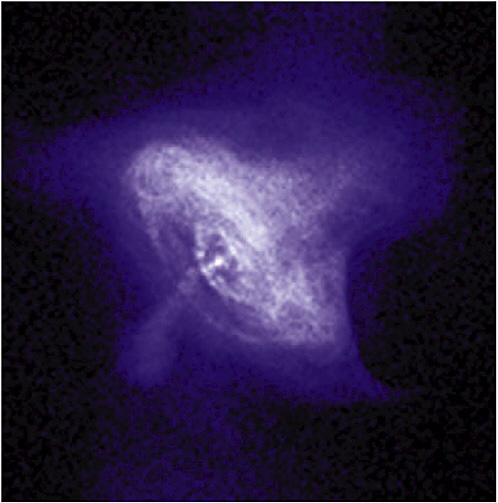
Most stars with a mass more than about eight times that of the Sun end their lives in a titanic explosion, a supernova, leaving behind a neutron star or a black hole (Figure 2.9). Stars less massive than about eight times the mass of the Sun evolve into red giants, so large that at the position of the Sun they would envelop the orbit of Earth. Their distended envelopes are ejected soon afterward, leaving behind a white
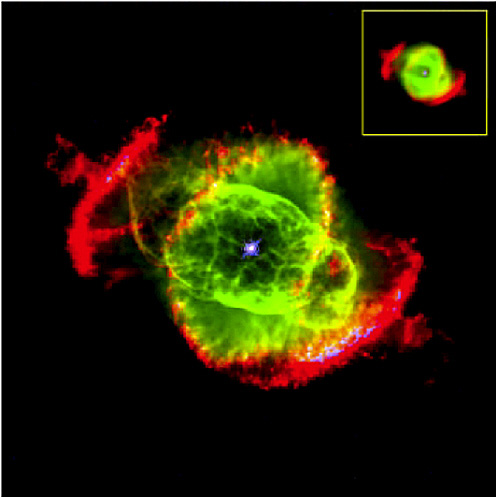
FIGURE 2.8 Hubble Space Telescope image of the planetary nebula NGC 6543, commonly known as the Cat’s Eye Nebula. The inset shows the lower-magnification ground-based image made using the 2.1-m telescope at Kitt Peak National Observatory under excellent atmospheric conditions. Stars with a mass less than about eight times that of the Sun evolve to red giant stars, and the red giants end their lives by ejecting their outer envelopes. The ejected envelopes glow in visible light and are called planetary nebulae. This image shows the ejected gas, enriched in elements such as carbon by the nucleosynthesis that occurred in the parent star, as it travels outward into the interstellar medium to be incorporated eventually into new stars and planets. The Hubble image was obtained by J.P. Harrington and K.J. Borkowski (University of Maryland), and NASA, and was recolored by B. Balick (University of Washington) with permission. The ground-based image is courtesy of B. Balick.
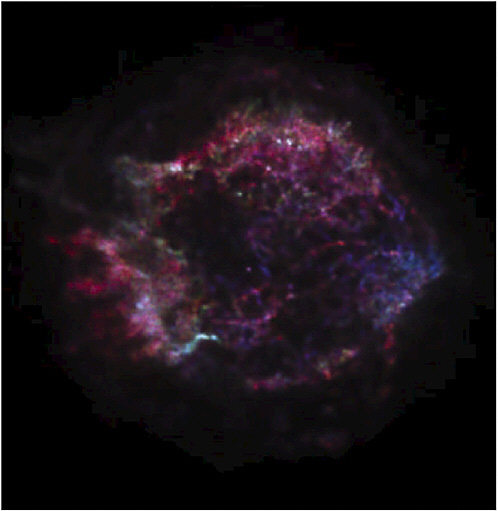
FIGURE 2.9 Two supernova remnants observed by the Chandra X-ray Observatory. On the left is an x-ray color image of Cassiopeia A, the remnant of a supernova that exploded about 300 years ago. The red, green, and blue regions show where the intensity of low-, medium-, and high-energy x rays, respectively, is greatest. The x rays from Cassiopeia A are produced by collisions between hot electrons and ions. The point source near the center is believed to be the compact stellar remnant—a neutron star or black hole—left behind by the explosion. On the right is an x-ray intensity image of the Crab Nebula, the remnant of the supernova of 1054 AD. The x rays from the Crab Nebula are produced by electrons that accelerate to nearly the speed of light and then spiral in the magnetic field of the nebula. Images courtesy of NASA, the Chandra X-ray Observatory Center, the Smithsonian Astrophysical Observatory, and J. Hughes (Rutgers University).
dwarf remnant (see Figure 2.8). For all these stars, some newly created elements are ejected from the surface in stellar winds before the final collapse. A major goal of stellar astrophysics is to understand the various mechanisms of mass loss and how they contribute to the continually increasing abundance of heavier elements in the universe. Many of the recommended new facilities will make strong contributions to the necessary investigations: ALMA and CARMA by studying the chemistry of the outflows, GSMT by acquiring spatially resolved spectra, and Constellation-X by observing the newly formed elements in supernova ejecta.
If a white dwarf has a closely orbiting companion star, it may accrete matter from the companion and become a supernova itself. Such supernovae (called Type Ia) have luminosities that can be calibrated, so that they can be used as standard candles. This means that their apparent brightness can be converted to distance. By measuring the distances and redshifts of many supernovae, it is possible to probe the geometry of the universe (is it flat or curved?) and determine how its expansion rate is changing with time. One of the major goals of stellar research during this decade will be to understand Type Ia supernovae both observationally and theoretically in order to calibrate their luminosities. LSST will aid in discovering large numbers of supernovae, and both NGST and GSMT will enable detailed study of their spectra even when they are at high redshifts.
Stars that are reborn as compact objects have such strong gravitational fields at their surfaces that they radiate high-energy photons when material falls on them, thus making them observable in the x-ray region of the spectrum. Neutron stars and white dwarfs also radiate the thermal energy stored in them at birth, and if they are magnetized and spinning, they can accelerate particles that also radiate. These objects provide laboratories in which matter can be studied under extreme conditions that cannot be duplicated on Earth. For example, the past decade saw the discovery of the theoretically predicted “magnetars,” which are neutron stars with magnetic fields 100 times that of normal neutron stars and a billion times that of the largest static fields in the laboratory. One of the major goals of Constellation-X is to image gas indirectly as it accretes onto a black hole, by studying how its spectrum evolves with time. Another goal is to measure accurately how the radius of a neutron star depends on its mass, which will tell researchers about the properties of matter at nuclear densities.
Gamma-ray bursts are mysterious phenomena discovered by satel-
lites that were monitoring the skies for possible thermonuclear test explosions. At its peak, the energy flux observed from a single burst can be greater than that from all of the nighttime stars and galaxies in the universe! The apparent brightness of the bursts led many astronomers to conclude that they had to be in our galaxy, but during the 1990s the Compton Gamma Ray Observatory found them to be equally distributed over the whole sky and therefore almost certainly extragalactic. The Italian-Dutch BeppoSAX satellite permitted more accurate localization of a few of the bursts, leading to the discovery of theoretically predicted afterglows at other wavelengths (Figure 2.10). Observational monitoring of these afterglows confirmed that the bursts originate from the far reaches of the universe. While the precise origin of the bursts remains a mystery, it is believed that they are most likely associated with the formation of compact stellar objects such as neutron stars and black holes (Figure 2.11). With GLAST, EXIST, and MIDEX missions such as Swift, it will be possible to find gamma-ray bursts that are fainter than those previously visible and to locate them more quickly for prompt follow-up observations at other wavelengths. Because they are so luminous, bursts associated with the first generation of star formation may be detectable.
GALAXIES
On very large scales, galaxies are the building blocks of the universe, as fundamental to astrophysics as ecosystems are to the environment. They come in a variety of types, ranging from disk galaxies like the Milky Way to elliptical and irregular systems. While visible primarily through the light from the stars they contain, galaxies are actually far more complex than a simple grouping of stars. Most of their matter is “dark” in that it is not visible at the sensitivity limits of today’s telescopes. Many galaxies, including our own, harbor supermassive black holes in their nuclei, and these will almost certainly have an important role in galactic evolution. Finally, in most galaxies there is a significant amount of gas and dust between the stars, out of which new stars continue to form.
FORMATION AND EVOLUTION OF GALAXIES
During the past decade astronomers were for the first time able to study galaxies so distant that their light was emitted when the universe was only a small fraction of its present age. From the work of Edwin
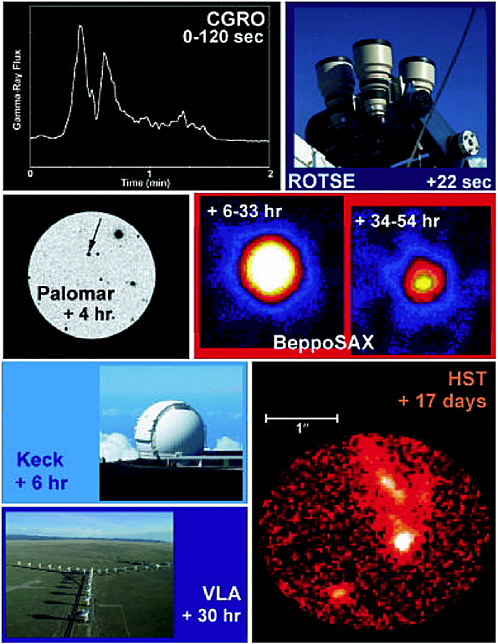
FIGURE 2.10 Observations at many wavelengths are needed to understand gamma-ray bursts. This gamma-ray burst was discovered by the Compton Gamma Ray Observatory (CGRO) on January 23, 1999. The optical flash from the gamma-ray burst was observed by the Robotic Optical Transient Search Experiment (ROTSE) 22 seconds later. Subsequently, the BeppoSAX satellite detected the x-ray emission from the burst. Based on preliminary information from BeppoSAX, astronomers at the Palomar Observatory identified the precise location. Astronomers at one of the Keck telescopes were then able to obtain the spectrum and determine the distance. Within a day, radio astronomers used the Very Large Array to observe the fading afterglow of the burst. After 17 days, the burst had faded enough so that astronomers using the Hubble Space Telescope could observe the host galaxy. This is probably the most energetic gamma-ray burst ever recorded. Images courtesy of NASA, CGRO BATSE Team, ROTSE Project, J. Bloom (Caltech), BeppoSAX GRB Team, W.M. Keck Observatory, NSF/NRAO, A. Fruchter (STScI), and P. Tyler (NASA GSFC).
Hubble in the 1920s, astronomers have learned that the universe is expanding in such a way that distant galaxies are moving away from us at higher speeds than are nearby ones. The expansion of the universe “redshifts” radiation to longer wavelengths, or from blue to red. Greater redshifts correspond to more distant galaxies. Since it takes light longer to travel greater distances, greater redshifts also correspond to earlier epochs in the universe (Figure 2.12). Galaxies have been discovered at redshifts up to about 5.
Astronomers are also able to study galaxies at high redshifts by taking advantage of the sensitivity and angular resolution available with the Hubble Space Telescope (HST). Deep observations of two patches of sky, one in the north and one in the south, have revealed the morphology of these distant galaxies (the northern deep field is shown on the cover of this report). The conclusion of these studies is that galaxies have undergone enormous evolution since they were young, with large galaxies probably growing out of mergers of smaller ones. Observations at submillimeter wavelengths have suggested that some galaxies contain sufficient dust so that they reprocess a significant fraction of their starlight into far-infrared emission. As a consequence, optical and near-infrared observations are blind to as much as one-half of the star formation that has occurred in galaxies—a problem that observations with ALMA, SAFIR, FIRST, and SIRTF will overcome. SPST will survey the sky at submillimeter wavelengths, finding many high-redshift galaxies that these other telescopes can target.
Galaxies are often found in clusters, and these clusters are thought to grow in size by the merging of smaller clusters. As gas falls into clusters, it is heated to very high temperatures and emits x rays. Constellation-X will
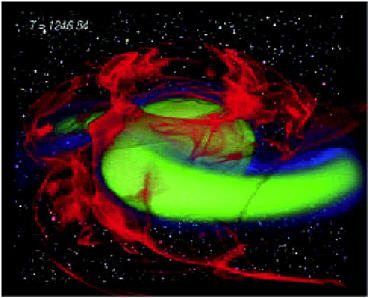
FIGURE 2.11 Simulation of two neutron stars spiraling into each other, ejecting hot gas (orange filamentary structures) and neutron-rich matter (blue/green, snail-shaped structure) in the process. Green represents higher-density matter than does blue. Gamma-ray bursts could be produced by such mergers. The white dots represent background stars added for visual effect. Simulation by P. Gressman (Washington University in St. Louis), and visualization by W. Benger (Max-Planck-Institut fur Gravitations Physik, Konrad-Zuse-Institut). Courtesy of the NASA Neutron Star Grand Chal-lenge Project.
be able to observe this emission from the first clusters of galaxies that form in the universe, revealing how they formed. Complementary observations with NGST and GSMT will show the evolution of clustering in cosmic time and how the cluster environment affects the evolution of galaxies.
As remarked above, present observations of galaxies do not extend much beyond a redshift of 5. The time between the “recombination” epoch at a redshift of about 1,000, when the cosmic background radiation was emitted, and that of redshift 5 remains completely unexplored. This period contains the “dark ages,” when the visible light of the Big Bang faded and darkness descended. The dark ages ended with the formation of the first stars and galaxies—the dawn of the modern universe. The new decade brings the possibility of seeing the first generation of stars and galaxies that mark this dawn. NGST is designed to have the sensitivity and wavelength coverage to detect light from the first generation of galaxies, out to a redshift of about 20. With NGST it will be possible to address a number of fundamental questions: When did the first galaxies and stars form? What is the history of galaxy formation in the universe? What is the history of star formation and element production in galaxies? The ability of ground-based optical and infrared telescopes to address these questions is severely compromised by the opacity and the thermal emission from the atmosphere at wavelengths longer than 2 µm. NGST will cover the spectrum out to wavelengths of at least
5 µm, so that, for example, it can observe the hydrogen-alpha line produced in regions of massive star formation to a redshift of about 6 and the 0.4-µm stellar absorption feature to a redshift in excess of 10. Extending the sensitivity of NGST farther into the thermal infrared would greatly increase its ability to study galaxies at high redshifts.
Most of the stars and most of the heavy elements in the universe were formed after the epoch corresponding to redshift 5. As described above, the past decade has seen pioneering studies of galaxies in this redshift range, but the sensitivity and resolution have not been adequate to determine how the morphological and dynamical structure of galaxies has evolved over time. With adaptive optics and its enormous light-gathering power, GSMT will be a powerful complement to NGST for addressing such questions. Existing observations indicate very disturbed morphologies, possibly due to mergers, for galaxies at redshifts beyond 1;
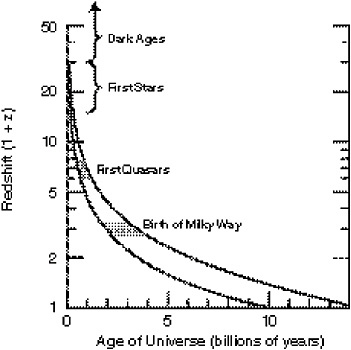
FIGURE 2.12 Relationship between the redshift and the time since the Big Bang (the age of the universe) for two different cosmological models. Both models are flat, but the one represented by the bottom curve has the critical density in matter, whereas that represented by the top curve (the currently favored model) has a cosmological constant so that only 30 percent of the critical density is in matter. At the time of the Big Bang, the age of the universe was zero, and the redshift (z) was extremely large. Later, prior to the formation of the first stars, the universe went through an epoch in which there was very little optical light—the “dark ages.” Estimates are shown of the redshifts at which the first stars formed, quasars formed, and the Milky Way formed. Today, 1 + z = 1; the age of the universe is 14 billion years in the currently favored model. See discussion on p. 86. Courtesy of M. Turner (University of Chicago).
GSMT and NGST will be able to distinguish the effects of mergers from those of rapid star formation. By means of spatially resolved spectroscopy, GSMT will be able to measure the masses of distant galaxies, thus providing crucial data for studying how galaxies evolve.
The history of galaxy evolution can also be inferred by studying the stellar populations of local galaxies at the present epoch. To do this requires the determination of the ages and elemental abundances of stars as a function of position in nearby galaxies. The high angular resolution available with GSMT means that it will be able to obtain the spectra of individual stars close to the nuclei of the Milky Way’s nearest large companion galaxies, M31 and M32 (Figure 2.13).
EVOLUTION OF THE INTERSTELLAR MEDIUM IN GALAXIES
The interstellar medium in a galaxy controls the rate of star formation and thus the evolution of the galaxy itself. It is the repository of the heavy elements produced in stars. If star formation becomes too violent, interstellar gas may be ejected from a galaxy into the surrounding intergalactic medium. An understanding of the interstellar medium is necessary if researchers are to address such key questions as the following: What are the physical processes that determine the rate at which stars form in a galaxy? What is the feedback between star formation and the interstellar medium? (See Figure 2.6 for an example.) What is the effect of the extragalactic environment on star formation?
All these issues come into play when the formation of the first galaxies is considered. The first galaxies formed out of enormous clouds of neutral atomic hydrogen. Once the galaxies had formed, the interstellar media of these galaxies remained primarily atomic hydrogen, although with increasing amounts of heavier elements as massive, short-lived stars ejected new elements into the medium. The hydrogen gas should be observable at redshifts above 10 with LOFAR. When the SKA is built, it will be able to map the atomic hydrogen up to redshifts of about 10. Within galaxies, some of the atomic gas will be converted to molecular form on its way to being incorporated into stars. If the earliest stars have ejected enough carbon and oxygen into the interstellar medium, the broad spectral capabilities of the EVLA will enable observation of carbon monoxide, the most abundant molecule after molecular hydrogen, out to redshifts beyond 10. Newly formed stars ionize some of the gas, producing emission lines detectable by NGST. Supernovae heat large volumes
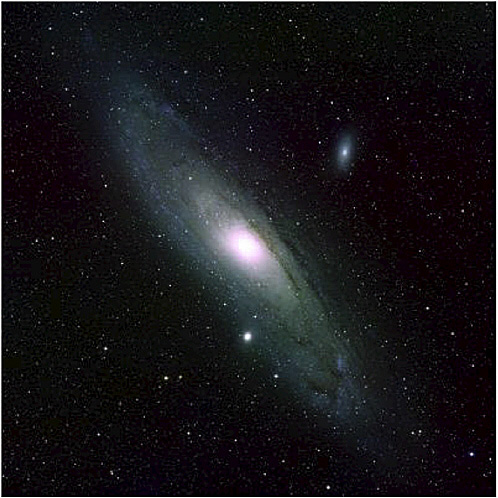
FIGURE 2.13 This optical wavelength picture shows the large spiral galaxy M31 (also known as the Andromeda Galaxy) and its small companions M32, lower center, and M110, to the upper right. Andromeda is the Milky Way’s closest large neighbor at a distance of about 2.2 million light-years, and it is very similar in appearance to, and slightly larger than, the Milky Way. In fact, M31 is visible to the naked eye, although we can see only the bright inner bulge. This image comes from photographic plates taken with the 0.6-m Burrell Schmidt telescope of the Warner and Swasey Observatory of Case Western Reserve University. GSMT will be able to study individual stars near Andromeda’s center, which is a very tightly packed star cluster not visible in this saturated image. Courtesy of B. Schoening (National Optical Astronomy Observatories) and V. Harvey (University of Nevada, Las Vegas, Research Experience for Undergraduates program sponsored by AURA/NOAO/NSF).
of the interstellar gas to millions of degrees, and x rays from this hot gas will be measured by Constellation-X to determine the temperature, pressure, and elemental abundances in this hot plasma. These same instruments will also permit astronomers to trace the evolution of gas in galaxies through cosmic time, as the universe synthesizes the elements needed to form planets and eventually to enable life.
Structure in the interstellar medium of a galaxy spans a wide range of scales, from much less than 1 light-year for the molecular cores that produce individual stars to 100,000 light-years for the galaxy as a whole. The gaseous galactic halo extends farther; it comprises both gas blown out of the disk and gas accreting from the intergalactic medium. Much of the mass of interstellar gas in disk galaxies is atomic and molecular gas that is quite cold, with a temperature that is less than 100 degrees above absolute zero. A substantial (but uncertain) fraction of the volume of such galaxies is filled by gas that has been heated to more than a million degrees by supernova explosions. There is also a significant amount of gas at intermediate temperatures that is heated by starlight. All this gas is permeated by cosmic rays, particles moving almost at the speed of light, and by magnetic fields. The primary hindrance to a greater understanding of how the interstellar medium mediates the evolution of galaxies is ignorance of the spatial distribution of these various components of the interstellar medium and how they are interrelated. Surveys of the interstellar medium in nearby galaxies with the recommended radio, infrared, x-ray, and gamma-ray facilities will provide valuable data on these issues. Understanding the complex structure of the interstellar medium and how it interacts with the process of star formation is a daunting theoretical problem for this decade.
GALACTIC NUCLEI
The nucleus of a galaxy is like a deep well: It is easy to fall in, but hard to get out. As a result, gas and stars accumulate there. In the 1960s, astronomers discovered that some galactic nuclei were truly remarkable: They could outshine an entire galaxy from a volume not much larger than that of the solar system. These objects, termed quasars, are the most luminous type of active galactic nucleus. Theorists immediately conjectured that such prodigious power output could come only from the accretion of gas onto a supermassive black hole; later it was realized that energy could be extracted from the spin of the black hole as well. A consequence of these ideas is that many galaxies should harbor
supermassive black holes in their nuclei. Three decades later, this conjecture has been amply verified. Observations of both gas and stars have shown that even in our own “backyard,” the Milky Way Galaxy harbors a black hole 3 million times more massive than the Sun (Figure 2.14)—and that black hole masses in the nuclei of other galaxies can exceed a billion solar masses. Exquisitely precise measurements of the positions and three-dimensional velocities of water masers made with the Very Long Baseline Array (VLBA) toward the nucleus of the galaxy NGC 4258 provided incontrovertible evidence for the presence of a supermassive black hole (Figure 2.15). ARISE has the power to study the water emission in other galactic nuclei to search for black holes and determine their mass and the characteristics of the accreting gas.
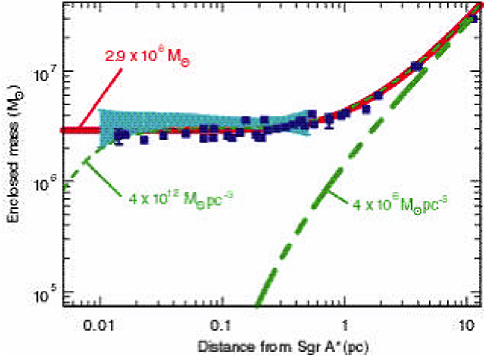
FIGURE 2.14 Evidence for a massive black hole at the galactic center, denoted Sgr A*. The data points are estimates of the distribution of mass, as determined from the motions of stars close to Sgr A*. The data (filled blue rectangles and light blue bars) are consistent with a 2.9 million solarmass black hole (thick red curve) or a hypothetical very dense dark cluster (thin dashed green curve) that can be ruled out on theoretical grounds. The data rule out that the observed motions are caused by the gravitational field of the observed stellar cluster (short and long dashed green curve). Courtesy of R. Genzel (Max-Planck-Institut fur extraterrestrische Physik).
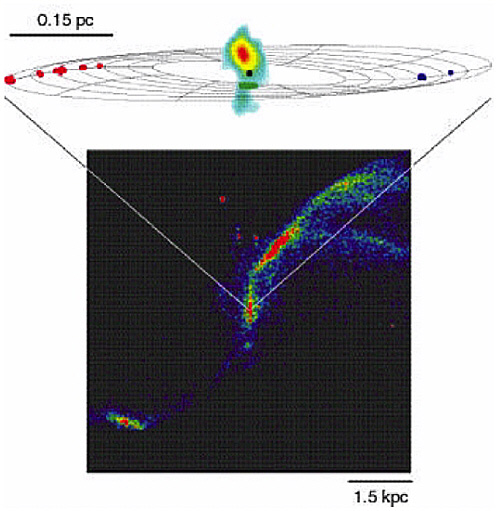
FIGURE 2.15 Some of the data that provide strong evidence for the presence of a supermassive black hole in the center of the nearby spiral galaxy NCG 4258. The top panel is the actual image of the point-like maser clouds constructed from very long baseline interferometry (VLBI) data having a resolution of 200 microarcsec (with a wire grid depicting unseen parts of the disk). Also shown is the image of the continuum emission at 1.3-cm wavelength caused by synchrotron radiation from relativistic electrons emanating from the position of the dynamical center (black dot). The central mass required to gravitationally bind the system is 39 million solar masses. Since all the mass must be within the inner boundary of the molecular disk of about 0.13 pc, this mass is probably in the form of a supermassive black hole. The bottom panel shows on a larger scale the synchrotron emission that arises from relativistic electrons ejected along the spin axis of the black hole. Courtesy of J. Moran and L. Greenhill (Harvard-Smithsonian Center for Astrophysics), and J. Herrnstein (National Radio Astronomy Observatory).
Observations with HST have confirmed that most nearby galaxies harbor supermassive black holes in their nuclei.
How do these supermassive black holes form and evolve? Do they grow from stellar “seeds” or do they originate at the very beginning of the formation of a galaxy? These key questions are ripe for a frontal attack now. Addressing them will require the observation of active galactic nuclei (AGNs) when they first turn on, over the entire electromagnetic spectrum. With its enormous sensitivity in the infrared, NGST will be able to detect AGNs out to redshifts beyond 10. Radiation emitted in the thermal infrared will be redshifted into the band detectable by SAFIR. The EVLA will detect much longer wavelength radio emission from AGNs to redshifts beyond 5. Constellation-X will be able to observe the first quasars even if they are heavily obscured by dust. EXIST will make a census of obscured, low-redshift AGNs over the whole sky; this sample can be compared with younger AGNs, seen at high redshifts by Constellation-X, to study how the AGNs evolve. In this case the energies of the most penetrating hard x rays will be conveniently shifted by the expansion of the universe into the energy region of maximum sensitivity of the telescope. Furthermore, by observing the spectrum of hot gas as it disappears into supermassive black holes, Constellation-X will provide a laboratory for studying the physical processes occurring near the event horizons of black holes under conditions that differ substantially from those near stellar-mass black holes.
In a tremendously scaled-up version of the process of mass ejection from disks around protostars, massive black holes not only accrete material but also eject from their vicinity powerful jets at nearly the speed of light (Figure 2.16). This highly relativistic material is thought to generate extremely energetic photons, with frequencies more than 100 billion times that of visible light. VERITAS has the power to detect individual photons of this radiation interacting with Earth’s atmosphere, and can therefore probe the relativistic particle acceleration occurring near these massive black holes. Observing somewhat less energetic photons, GLAST will help determine how jets are powered and confined. ARISE has the spatial resolution to resolve the base of the jet and thereby provide a complementary probe of the acceleration region.
Galaxy mergers are inferred to be common, and it is quite possible that the massive black holes in their nuclei would merge as well. Such a cataclysmic event would produce powerful gravity waves that could be detected by LISA out to very large distances (redshifts up to at least 20). This gravitational radiation would be detectable for up to a year before
the actual merger, enabling accurate prediction of the final event so that it could be observed by telescopes sensitive to the entire range of electromagnetic radiation. Observation of such a merger would provide a unique test of Einstein’s theory of general relativity in the case of strong gravitational fields. Further discussion of what scientists can learn about black holes can be found in the physics survey report Gravitational Physics: Exploring the Structure of Space and Time (NRC, 1999).
Galactic nuclei can become extremely luminous as a result of intense bursts of star formation or the presence of a supermassive black hole.
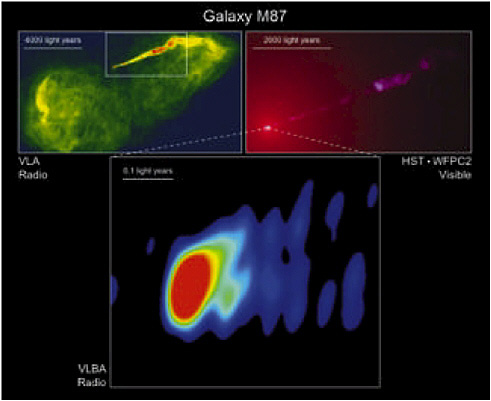
FIGURE 2.16 The jet produced by the central black hole in the galaxy M87. The Very Large Array (VLA) image at the upper left shows the radio emission powered by the jet. The Hubble Space Telescope (HST) image at the upper right shows the narrow jet at similar resolution. Finally, the Very Long Baseline Array (VLBA) image at the bottom, with more than 100 times the resolution of the HST image, is the closest view of the origin of such a jet yet obtained. Courtesy of NRAO, STScI, W. Junor (University of New Mexico), J.A. Biretta and M. Livio (STScI), and NASA. Reprinted by permission from Nature 401:891-892, copyright 1999 Macmillan Magazines Ltd.
These “starbursts” may be associated with the initial formation of the galaxy, or they may be triggered by an interaction with another galaxy. Starbursts are of great interest because they represent an extreme form of star formation that is not understood; for example, it is not known whether they produce the same distribution of stellar masses as that observed in our galaxy. Distinguishing starbursts from supermassive black holes is complicated by the fact that AGNs are often shrouded in dust, so that much of the direct emission is hidden from view. Long wavelengths penetrate the dust more readily, so the EVLA, SAFIR, and NGST with an extension into the thermal infrared are all suitable for separating the two phenomena. Very-high-energy photons can also penetrate the dust, so Constellation-X and EXIST will provide relevant data as well.
Active galactic nuclei may be the source of ultrahigh-energy cosmic rays (gamma-ray bursts and intergalactic shocks have also been suggested as the source of these enigmatic particles). These cosmic rays are generally assumed to be protons that have been accelerated to very high energies. The energies are so large—equivalent to the energy of 1 billion to 100 billion protons at rest—that these cosmic rays can propagate only a limited distance before losing their energy through interactions with the cosmic microwave background radiation. Ongoing experiments with the Fly’s Eye in Utah and proposed experiments with the Southern Hemisphere Pierre Auger Observatory project will add greatly to our knowledge of these cosmic rays, particularly if the experiments are able to identify their sources.
THE UNIVERSE
Observations by NGST should witness the first light from distant galaxies. Long before the stars that emitted this light were formed, the matter making up the galaxies had to accumulate from the intergalactic medium. This process of galaxy formation occurred within the background of an expanding universe. How has the universe evolved through cosmic time? How did structures such as galaxies and clusters of galaxies develop in the expanding universe? Finally, observations show that not all the matter that makes up galaxies and clusters of galaxies is visible: What in fact is the composition of the universe?
THE EVOLUTION OF THE UNIVERSE
Evidence indicates that somewhat more than 10 billion years ago the universe was created in a titanic explosion—the Big Bang. What may have preceded this event is unknown. The Big Bang theory allows us to trace the evolution of the universe back to a time when it was just a soup of elementary particles—a few microseconds after the beginning. Researchers have promising ideas that would enable extending understanding back to a time before particles existed, when even the largest objects in the universe were quantum fluctuations. How has the universe expanded since the Big Bang? Astronomers measure the expansion of the universe through the redshift of the radiation observed. The greater the redshift of light from an observed object, the more the universe has expanded since that radiation was emitted. The relationship between the redshift and time—the calibration of the cosmic clock—determines how long ago the radiation was emitted (see Figure 2.12). Using the speed of light to convert time to distance, this relationship can be also be used to determine the geometry of the universe (whether space is flat or curved). The current time scale for the expansion is set by a parameter known as the Hubble constant, which gives the relation between redshift and distance. Using HST and other telescopes, it has been possible to establish the value of the Hubble constant with an accuracy approaching 10 percent.
In order to derive the age of the universe from the measured value of the Hubble constant, it is necessary to know how the expansion has accelerated or decelerated with time. The history of the expansion of the universe depends on the total density of matter in the universe (both ordinary matter and dark matter) and on the possibly non-zero “cosmological constant,” which might characterize a sort of “dark energy” in the universe. These parameters determine the geometry of the universe and its ultimate fate, whether it will expand forever or eventually recollapse. Theory suggests that the geometry of the universe is flat; in this case, the total density of matter and energy is said to have its “critical” value. Observations of distant clusters of galaxies indicate that the density of matter is about 30 percent of the critical value.
One of the most exciting developments of the past decade has been the discovery that the cosmological constant may not be zero—our universe appears to be filled with dark energy. This discovery is based on
two independent sets of observations. First, astronomers have found a way to determine the luminosity of Type Ia supernovae from the rate at which their light declines. Knowledge of the luminosity enables the determination (or calculation) of the distance to such a supernova by measuring its brightness. The results show that distant supernovae appear fainter than expected, suggesting that the expansion of the universe is accelerating. When combined with other data, the observations of supernovae lead to the conclusion that dark energy makes up perhaps 70 percent of the total density of matter and energy. Second, observations of fluctuations in the cosmic microwave background (discussed below) strongly suggest that the universe is indeed flat, so that the total density of matter and energy is at the critical value. Since estimates of the masses of clusters of galaxies show that the matter density of the universe has only about 30 percent of the critical value, it follows that the dark energy must make up the remaining 70 percent. Together with the value of the Hubble constant determined above, the estimated values of the matter and energy densities yield an age for the universe of about 14 billion years.
During this decade, observers and theorists will work to understand and extend these observations. Confirmation that dark energy exists, with a density that rivals that of matter, would be a physical discovery of the most fundamental significance. Planned observations of the cosmic microwave background will provide more accurate values of the cosmological parameters, including the density of ordinary matter. This value of the matter density, when compared to an equally precise determination derived from a measurement of the primeval deuterium abundance, will allow a fundamental consistency test of the standard cosmology. Recent measurements of the deuterium abundance in distant galaxies indicate that this test is feasible; however, a definitive measurement of deuterium is still needed. NGST will permit the observation of many supernovae at high redshifts, to confirm whether the universe is actually accelerating. Discovery of a much larger number of supernovae with LSST, followed up by more sensitive and precise measurements from ground- or space-based telescopes, will permit the cosmic clock to be calibrated with much greater precision. It should then be possible to determine whether the cosmological constant is really constant, as Einstein assumed, or evolving with time, as some current theories suggest.
THE EVOLUTION OF STRUCTURE IN THE UNIVERSE
The seeds of the structure of the universe down to the scale of galaxies, and probably even smaller, were planted by tiny quantum fluctuations in the first instants of the Big Bang. In order to study how the large-scale structure in the universe grew from these seeds, it is necessary to study how galaxies are distributed in space today. Surveys of galaxies carried out more than a decade ago revealed large voids where few galaxies were visible, and other regions where the density of galaxies was enhanced on scales up to 300 million light-years in extent. Surveys of galaxies during the past decade have shown that this appears to be the limiting scale on which large fluctuations in density occur: On larger scales, the universe appears to be smooth. Surveys under way now, particularly the Sloan Digital Sky Survey, will provide a far more accurate map of the distribution of galaxies in the nearby universe.
Direct evidence for the early fluctuations that led to this structure is imprinted on the oldest radiation in the universe, the cosmic microwave background (CMB). This radiation was emitted at a redshift of about 1,000, or a time only several hundred thousand years after the Big Bang, when the temperature of the radiation was somewhat less than that at the surface of the Sun. Today, the temperature of the background radiation is 1,000 times lower, just 3 degrees above absolute zero, having been cooled by the expansion of the universe. This radiation was observed with remarkable accuracy by the Cosmic Background Explorer (COBE), launched in 1989. Data from this satellite showed that the radiation had the theoretically predicted spectrum of a blackbody. COBE data also revealed tiny spatial ripples in the intensity of the radiation (Figure 2.17), indicative of density fluctuations that could lead to the observed large-scale structure of the universe. This set of satellite observations provided, for the first time, direct experimental evidence for a basic paradigm of scientists’ cosmological speculations and established the quantitative basis for all subsequent work in this field.
By design, the COBE satellite had very low angular resolution, and therefore it was able to measure structure in the background radiation only on the largest scales. The characteristics of the background radiation on smaller scales depend on the matter and energy content of the universe; in concert with studies at lower redshifts, such as the Sloan Digital Sky Survey and searches for supernovae, these data can be used to determine all the fundamental properties of the universe, including its age and the amount of matter and energy it contains. Recent observa-
tions imply that the total density of matter and energy is very close to what is needed to make the geometry of the universe flat (see Figure 2.18). NASA’s MAP, the European Space Agency’s Planck Surveyor satellite, the ground-based Cosmic Background Imager, and future balloon observations will dramatically increase the sensitivity of studies of the background radiation. In addition to measuring the fundamental cosmological parameters with great precision, these missions will provide stringent tests of current cosmological theories. Ground-based studies will measure the distortion of the spectrum of the background radiation caused by the hot gas in intervening clusters of galaxies. Combined with observations by Constellation-X of the properties of this hot gas, these observations will enable researchers to determine the distances to these clusters, constrain the value of the Hubble constant, and probe the large-scale geometry of the universe.
One aspect of the cosmic microwave background that these missions will only begin to investigate is its polarization. Gravitational waves excited during the first instants after the Big Bang should have produced effects that polarized the background radiation. More precise measure-
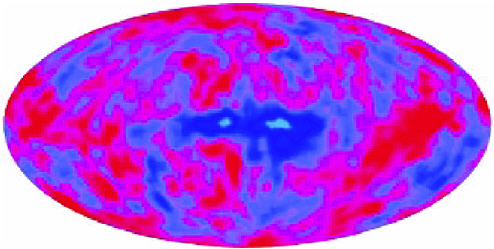
FIGURE 2.17 The COBE satellite detected tiny variations in the intensity of the cosmic microwave background. The amplitude of the temperature fluctuations is only about 0.00001 K, which reflects the smoothness of the universe at the time this radiation was emitted, and dramatically confirms the theoretical expectation that the universe began from a dense, hot, highly uniform state. The COBE data sets were developed by NASA’s Goddard Space Flight Center under the guidance of the COBE Science Working Group and were provided by the National Space Science Data Center.
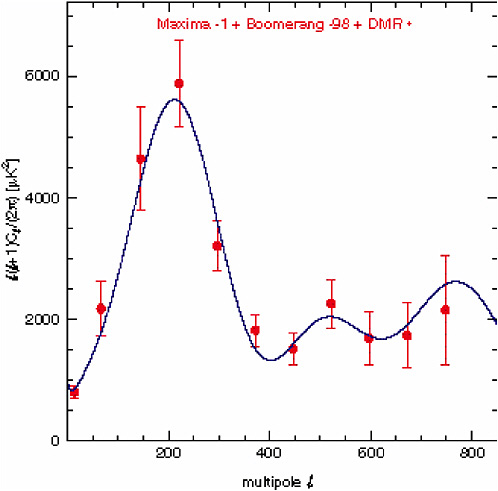
FIGURE 2.18 The spectrum of the primordial sound produced by the Big Bang. The sound waves can be observed through the fluctuations they produce in the temperature of the cosmic microwave background. Plotted is the mean-square temperature difference between two points in the sky as a function of their angular separation parameterized by the multipole number l (angular separation ~ 180 degrees/l). The observations were made with the BOOMERANG and MAXIMA balloon-borne telescopes; data from the COBE differential microwave radiometers (DMR) are also included. The peak in the spectrum at about 1 degree (l ~ 200) indicates that the universe is nearly spatially flat. The data can be fit well by models (such as that shown by the solid blue curve) in which only a small fraction of the matter is normal baryonic matter. Courtesy of the BOOMERANG and MAXIMA collaborations.
ments of the properties of this polarization—to be made by the generation of CMB missions beyond Planck—will enable a direct test of the current paradigm of inflationary cosmology, and at the same time they will shed light on the physics of processes that occurred in the early universe at energies far above those accessible to Earth-bound accelerators.
COMPOSITION OF THE UNIVERSE
Ordinary matter is made up of the same atoms as are known to us on Earth. The nucleus of an atom consists of protons and neutrons. The electrons encircling the nucleus are equal in number to the protons, although some of these electrons are stripped from the atom if the atom is ionized. Atoms can combine together into molecules, which in turn combine together to form all the matter we see on Earth. Atoms can produce light, and by observing light from stars astronomers have concluded that the stars, too, are made up of atoms. But when astronomers observe larger objects, such as the outer parts of galaxies or entire clusters of galaxies, they have found that the amount of matter they see in glowing gas and stars is not enough to hold these objects together by gravity. They therefore have postulated a form of matter too faint to see through its radiation: dark matter.
The current state of knowledge of the composition of the universe is shown in Figure 2.19. As discussed above, recent observations have suggested that the total density of matter and energy is the critical value necessary for a flat universe. Of this total critical value, about two-thirds is dark energy, whose nature is unknown, and one-third is matter. Ordinary matter is about 5 percent of the total, and luminous stars make up only about 0.5 percent. Where is the ordinary matter that is not in luminous stars? A leading contender for at least some of this missing ordinary matter is hot intergalactic gas, and Constellation-X will test this hypothesis. An even greater mystery is the nature of the matter that is not made up of atoms—the dark matter. Some of this matter is composed of neutrinos left over from the Big Bang. Although the uncertainty in their mass makes it difficult to determine exactly how much, astrophysical observations suggest that neutrinos do not account for the bulk of the dark matter. The rest is believed to be in the form of dark matter particles or objects that move relatively slowly, and are therefore called “cold” dark matter. Determination of the nature of this cold dark matter is one of the great unsolved problems in modern astrophysics.
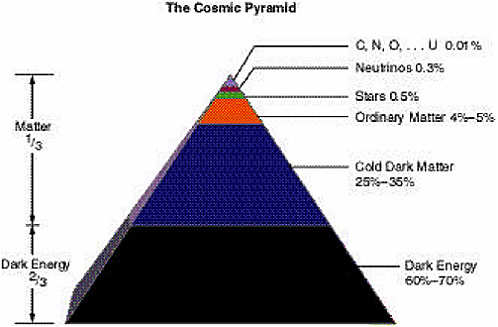
FIGURE 2.19 The makeup of our universe. Two-thirds of the matter and energy in the universe is in the form of a mysterious form of dark energy that is causing the expansion of the universe to speed up, rather than slow down. The other third is in the form of matter, the bulk of which is dark and which scientists believe is composed of slowly moving elementary particles (cold dark matter) remaining from the earliest moments after the birth of the universe. All forms of ordinary matter account for only about 5 percent of the total, of which only about one-tenth is in stars and a very tiny amount is in the periodic table’s heavier elements (carbon, nitrogen, oxygen, and so on). The idea of particle dark matter was reinforced by recent indications that neutrinos have mass and thereby account for almost as much mass as do stars. Adapted from a drawing courtesy of M. Turner (University of Chicago).
The large-scale distribution of the dark matter can be studied through observations of gravitational lensing. Studies of gravitational lensing have given astronomers their best look at the distribution of dark matter both in clusters of galaxies and around some individual galaxies. In this decade, surveys of galaxies over vast areas of the sky with LSST and other telescopes will provide lensing data that describe the dark matter distribution over supercluster scales—information crucial for understanding the growth of large-scale structure.
Two leading possibilities for the makeup of dark matter are (1) elementary particles left over from the earliest moments of creation and (2) objects of stellar mass (massive compact halo objects, or MACHOs). It is a mark of the uncertainty in this field that these two candidates differ in mass by more than 57 orders of magnitude.
Theorists predicted that MACHOs, though too faint to be detected by their own emission, could be detected by gravitational lensing as well: The light of the background star would be amplified as the MACHO passed in front of the star. During the past decade, several groups independently detected this phenomenon, which is called microlensing because the mass of the lens is so small compared with that of galaxies (Figure 2.20). The nature of the MACHOs is a significant mystery: Are they stars made up of ordinary matter, or are they objects made up of an exotic form of matter? Accurate determination of their masses would help resolve this question, but to date, definitive measurements have not been possible; the best estimate is that the typical mass of a MACHO is somewhat less than a solar mass. By resolving the apparent motion of the stars that are imaged by the MACHOs, SIM will measure the masses of the MACHOs. Studies of microlensing have had several important spinoffs, including resolution of the surface of the star being lensed, and demonstration that it should be possible to detect planets as small as Earth through microlensing observations, as discussed in “The Formation and Evolution of Planets” section of this chapter.
As yet it is unclear how much MACHOs contribute to the dark matter in the Galaxy. If MACHOs are made of ordinary matter, then they cannot account for the bulk of the dark matter known to exist in the universe or even in our own galaxy. As a result, a number of efforts are under way in laboratories around the world to discover the particle dark matter that may be holding our own Milky Way together. There are two important
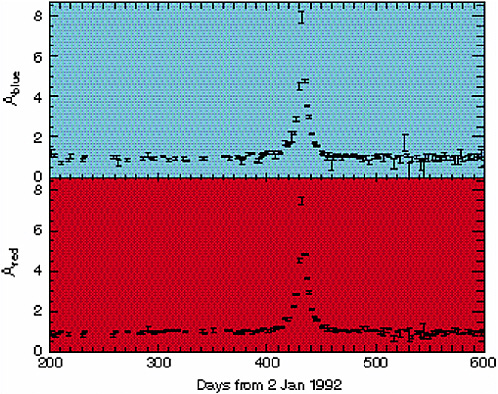
FIGURE 2.20 The first gravitational microlensing light curve, showing the amplification of the light of a background star by the gravitational field of an intervening object. These intervening objects, of unknown nature, may contribute to the dark matter in the Galaxy. The similarity of the curves in red light and blue light helps confirm that the brightening is caused by gravitational lensing. Courtesy of the MACHO collaboration. Reprinted by permission from Nature 365:621-623, copyright 1993 Macmillan Magazines Ltd.
ongoing efforts in the United States: (1) the Cryogenic Dark Matter Search II, a search for a particle with roughly atomic mass called the neutralino, and (2) the U.S. Axion Experiment, a search for an extremely light dark matter particle called the axion. The existence of the neutralino is a prediction of superstring theory, a bold and promising attempt to unify gravity with the other forces of nature. The discovery that neutralinos or axions are the dark matter that binds our own galaxy would shed light not only on the astrophysical dark matter problem, but also on the unification of the fundamental forces and particles of nature.


